風
fengshuiauspice.com
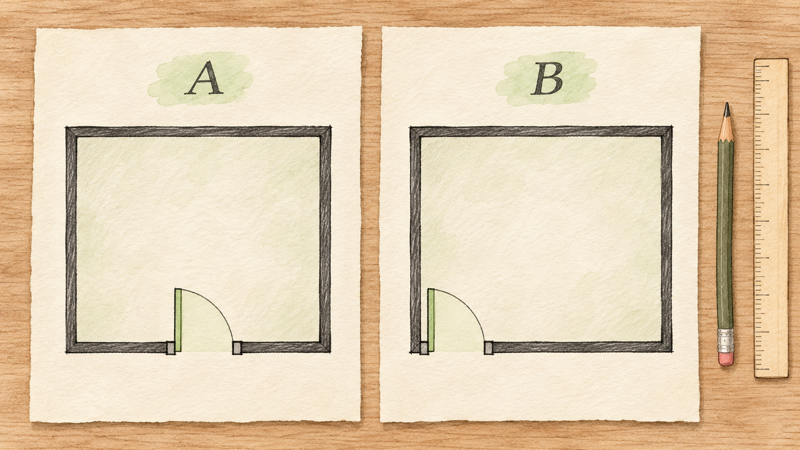
Quick Answer: Feng shui front door placement begins by separating the door’s position in the floor plan from its facing direction and swing. Record where the opening sits, how people approach it, where the leaf moves, and what happens immediately inside. A door can move along the same straight wall without changing its facing direction. A compass bearing alone cannot show whether the entry route works for the people using it.
This guide explains how to read an entrance layout. It does not assign one universally lucky location or tell you to cut a new opening in an exterior wall. Existing-home adjustments and a proposed door relocation are different kinds of decisions.
| Feature | Question it answers | What to record | What it leaves unanswered |
|---|---|---|---|
| Position | Where is the opening within the wall and plan? | Opening location and nearby rooms or corners | Compass bearing |
| Facing direction | Which direction does the entrance face? | Measurement method, viewpoint and bearing | Space for someone to open and pass through |
| Swing | Where does the moving leaf travel? | Hinge side, opening side and arc | The entrance’s complete approach route |
| Approach and landing | How does a person arrive and stand at the door? | Path, level changes and usable standing area | Traditional symbolic interpretation |
| Interior route and view | Where do people and sightlines go next? | Walking route, furniture and immediate view | A prediction about luck or life outcomes |
When someone asks whether a door is “in the wrong place,” identify which row describes the concern. A visitor who cannot find the entrance, a door leaf that hits a cabinet, and an unwanted view into a private room are three different problems. They need different observations before any change is proposed.
In an article published by the Feng Shui Society, practitioner Susan Izzard describes the front door through the traditional “Mouth or Gate of Chii” idea. This explains why the entrance receives attention within that practice. It is a statement of a cultural framework, not evidence that moving a door causes wealth, health or relationship changes.
You can discuss that symbolic importance while keeping physical observations separate. “The bench narrows the route” describes something visible. “The door faces a particular compass direction” describes a measurement. A claim about qi or auspiciousness belongs to a stated interpretive system; it does not supply the missing measurement or demonstrate a future outcome.
For bearing questions, use the separate front door direction guide. Writing down the reference point prevents an outside-facing view, a view from inside, and the position of the moving leaf from being mixed together.
Imagine arriving with a bag, accompanying a child, or using a mobility aid. Where do you approach from? Can you reach the handle and stand clear of the moving leaf? Where do you go after crossing the threshold? A photograph of the closed facade cannot answer every one of those questions.
The U.S. Access Board’s entrance guide treats the accessible route, landing and door maneuvering area as related parts of an entrance. Its door-clearance discussion distinguishes approach direction, door swing and, in some cases, latch or closer conditions. That is a useful technical example of why an opening cannot be assessed from its width or compass direction alone.
The guide addresses U.S. ADA requirements. Its dimensions and applicability should not be copied as a universal rule for every private home or jurisdiction. For a real project, the relevant local requirements and users’ needs must be established. Here, the immediate task is to record the layout accurately.
On a plan, show the door leaf and its swing arc, then add the furniture that actually occupies the entrance. Include objects that move in daily use: a bench pulled forward, a stroller parked temporarily, a cabinet door left open. An empty architectural plan and the furnished route can behave differently.
For example, suppose the entry works when empty but the leaf strikes a shoe cabinet after furnishing. Moving the cabinet may resolve the collision without relocating the entrance. If the difficulty is a tight landing outside the door, rearranging an interior lamp does not address it. Describe the physical problem first so that the proposed change acts on the right part of the layout.
Opening direction is also a separate design question. Do not reverse a door simply because a general feng shui list prefers inward or outward opening. The route, hardware, building conditions and applicable requirements need to be considered together.
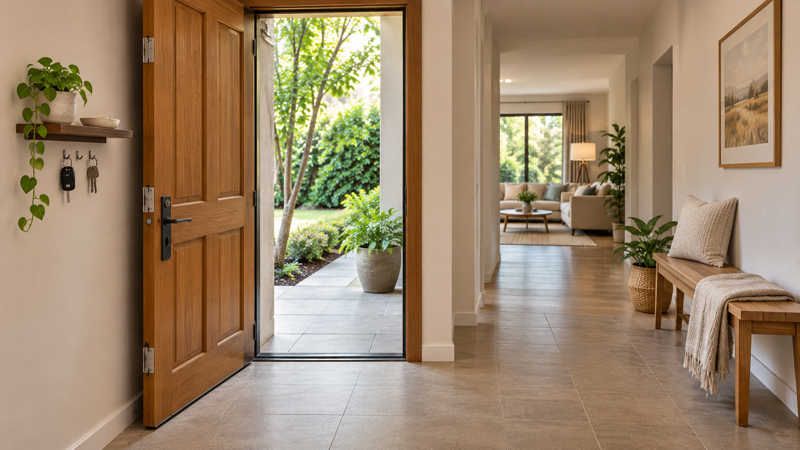
Stand at the threshold and describe the actual view. Is a bedroom directly visible, or is the concern simply that the hall feels visually abrupt? Next, examine whether a furniture adjustment, a different room-use arrangement or another appropriate interior change could help without obstructing movement.
A tall screen placed directly in the opening can trade one concern for another. Before adding it, check whether it narrows the route, conflicts with the leaf, or makes the entry harder to navigate. A solution should be assessed in the furnished plan, not judged only from a flattering camera angle.
The same distinction applies outside. An offset entrance is not automatically defective, and a centered entrance is not automatically successful. Ask whether the approach reaches it clearly and whether the landing and internal route work. Symmetry and usability are different qualities.
Moving the opening can affect much more than the floor-plan line. The Building America Solution Center’s door guidance discusses the frame, air sealing, weatherstripping and waterproof flashing around an exterior doorway. These are physical building-envelope details, not decorative accessories.
For a proposed relocation, have the relevant building professional assess structure, weather protection, access and any required approvals for that property. This guide does not provide demolition or installation instructions. A renter or apartment owner should also distinguish personal furniture choices from changes involving the building entrance or common areas.
Useful material for a review includes an annotated plan, photographs from both sides, hinge and swing information, the approach route and a short description of the problem. “The leaf hits the cabinet when opened” is a more actionable brief than “the entrance feels unlucky.”
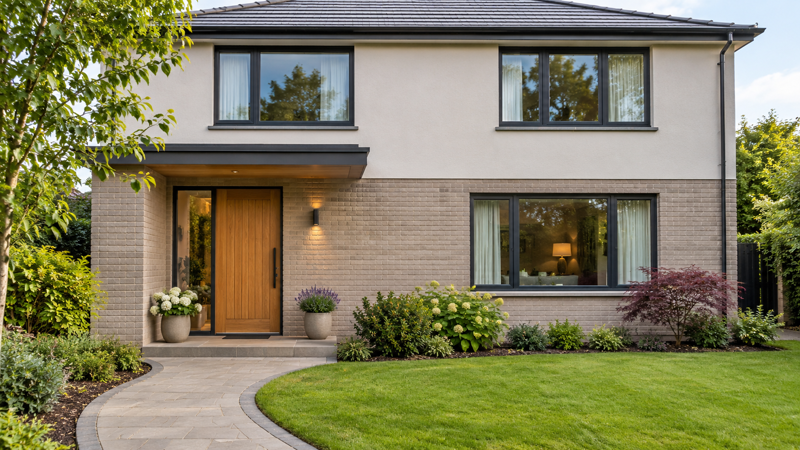
No. Placement describes where the opening sits in the plan. Facing direction describes its orientation. Moving an opening along the same straight wall need not change that orientation.
There is no universal centered-door rule established by this guide. Assess the approach, usable landing, swing, interior route and relevant building requirements.
First identify whether the furniture is the cause and whether an appropriate furniture change resolves it. A door relocation is a different, more involved building decision.
No guaranteed life outcome is supported here. Traditional interpretation should be distinguished from measurable access, layout and building-envelope conditions.
The practitioner article supports the attributed cultural idea; the Access Board and Building America sources support the separate access and building-detail discussion. All were checked on November 4, 2026. Examples and generated images are conceptual, not a surveyed property, a compliance certificate or a construction plan.
For the separate dimensions question, see front door size and clear-width measurement. For movable additions, see front door decor and entry clearance.
Get a detailed feng shui report based on your zodiac, birth year and space layout.
View PackagesPowered by Shanyue Group | Contact: contact@shanyuegroup.com
About | Contact | Privacy Policy
© 2026 Shanyue Group • All Rights Reserved