Where should I stand to measure my front door direction?
Face outward perpendicular to the exterior plane of the door. Start at the threshold, move away if metal interferes, and record the distance and position used.
Quick answer: To measure feng shui front door direction, face outward along a line perpendicular to the exterior plane of the closed door, hold a compass level, move away from metal interference, and take several readings. Record the bearing, the distance from the door, and whether it is magnetic or true north. Only then interpret the direction within one chosen feng shui system. A direction is not automatically lucky or unlucky, and it does not override safety, access, maintenance, or the actual layout.
The phrase “front door direction” often mixes three separate questions: Which door is the home’s main entrance? Where do you stand to measure it? Which feng shui school will interpret the number? If those choices are not written down, two readings can disagree even when both people are careful.
Start with a repeatable measurement. Then keep the cultural interpretation bounded. UNESCO’s description of the Site of Xanadu says the site was planned according to traditional Chinese feng shui in relation to nearby mountains and a river, so orientation is documented in historical planning. That does not prove that a modern residential bearing guarantees wealth, health, or relationships.

For a practical home audit, the front door’s facing direction is the outward bearing through the main entrance. A reading of 90° is east, 180° is south, 270° is west, and 0° or 360° is north. Intermediate bearings fall between the cardinal directions.
That number is measurement data, not a diagnosis. It can be combined with a bagua, Eight Mansions, Flying Stars, or another system, but those systems use direction differently. Do not copy a color rule from one school, a personal direction from another, and a renovation date from a third, then treat the mixture as one calculation.
| Question | Record | Why it matters |
|---|---|---|
| Which door? | The entrance normally used to enter the home, plus any building lobby door in an apartment | Prevents switching between unit and building readings |
| Where did you stand? | At the threshold or a recorded distance away, facing outward perpendicular to the exterior plane of the door | Makes a later recheck repeatable |
| What north reference? | Magnetic or true north | Avoids mixing two bearing systems |
| How many readings? | At least three, taken after checking interference | Reveals unstable measurements |
| Which interpretation system? | Name the school or method | Keeps the meaning consistent |
Iron and steel objects can affect compass readings. The U.S. Geological Survey also distinguishes magnetic north from geographic, or true, north. Those are measurement facts; feng shui interpretation begins only after the bearing is stable.
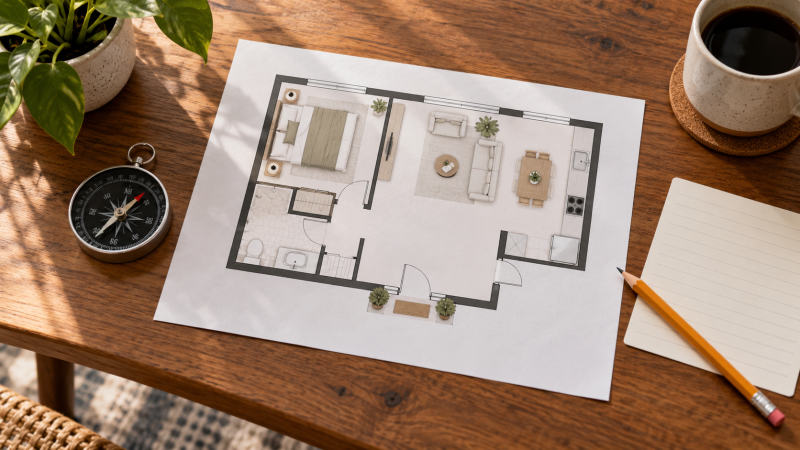
A magnetic compass does not usually point exactly to geographic north. The angle between them is called magnetic declination, and the USGS explains that it varies with location and time. A phone or mapping app may display true north while a physical compass displays magnetic north.
This does not mean one is universally the “feng shui correct” choice. It means you must keep the convention consistent. If a consultant, course, or reference table expects magnetic bearings, do not feed it a true-north reading without conversion. If it expects true north, record the current declination source and date.
An apartment has at least two relevant thresholds: the building entrance and the unit door. A gated complex may add more. For a unit-level layout reading, the unit door is usually the practical starting point because it controls entry into the private home. For building-level context, the lobby or main building entrance may also matter within some schools.
Record both rather than forcing them into one number:
If a school defines the facing side by the most active open space rather than the door alone, state that rule explicitly. Do not quietly replace “front door direction” with “building facing direction.”
Once you have a stable bearing, use it as one layer of a home assessment. Direction can organize symbolic associations, but the lived entrance still needs to open, light, drain, lock, and support clear movement. Read our broader front door feng shui audit before buying decorative cures.
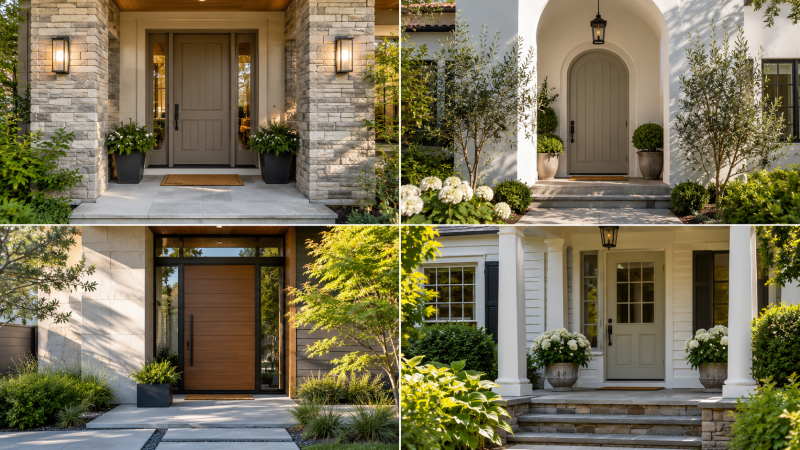
If color is the actual decision, use the separate front door color meaning guide. If the concern is a reflective surface in the entry, see the entryway mirror placement guide. Those pages answer different tasks and should not be collapsed into a direction chart.
Face outward perpendicular to the exterior plane of the door. Start at the threshold, move away if metal interferes, and record the distance and position used.
Use the reference required by your chosen system and record it. The important rule is not to mix magnetic and true bearings without an explicit, current declination conversion.
For a unit-level reading, start with the unit’s main entry door. Record the building entrance separately if your method also evaluates the whole building.
No. Feng shui schools interpret direction within larger frameworks, and no bearing guarantees a life outcome. Practical function, safety, access, and the actual layout remain essential.
Bottom line: A feng shui front door direction is useful only when the measurement is repeatable and the interpretation system is named. Measure first, document the north reference, then keep symbolism separate from observable building facts.
Get a detailed feng shui report based on your zodiac, birth year and space layout.
View PackagesPowered by Shanyue Group | Contact: contact@shanyuegroup.com
About | Contact | Privacy Policy
© 2026 Shanyue Group • All Rights Reserved