For feng shui office doors, begin with a doorway that is easy to approach, opens without hitting furniture, and supports the privacy the room needs. Then consider how the entrance feels and what you see from the desk. A symbolic preference should not lead you to block a route, interfere with door hardware or expose a confidential screen.
The door to a private office, a home study and an entrance to a shared workplace have different jobs. Before buying a mirror or moving the desk, name the problem: a crowded threshold, an awkward opening arc, interruptions, glare, or visitors looking straight at your work. This guide concentrates on that threshold; it does not assign one lucky direction to every office.
Office doorway checklist: access, swing and privacy
| Check | What to observe | Useful first response |
|---|---|---|
| Approach | Bags, deliveries or a chair narrow the route. | Move stored items to a proper location outside the passage. |
| Door swing | The opening door contacts furniture or a person. | Review furniture placement before touching hinges or a closer. |
| Seated view | You cannot see an arriving visitor without twisting. | Try a modest desk adjustment while preserving circulation. |
| Privacy | The doorway reveals a screen or a private conversation. | Review screen orientation and the room’s agreed open/closed-door use. |
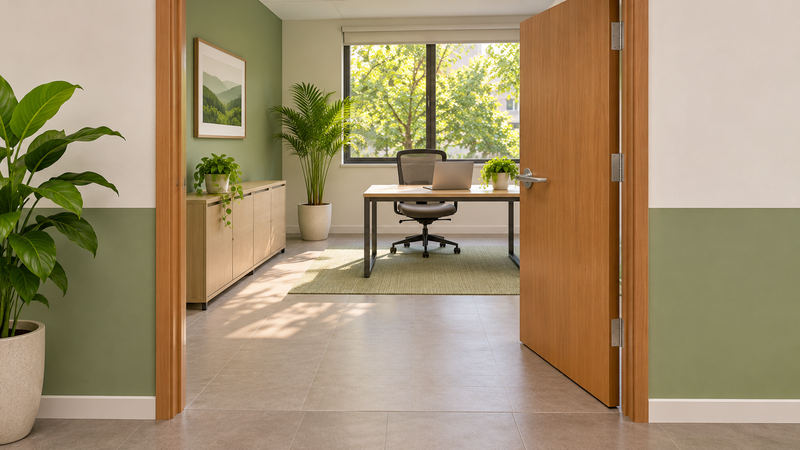
Separate entrance symbolism from measurable conditions
In an article for the Feng Shui Society, Susan Izzard describes the home’s front door as the “Mouth or Gate of Chii.” This is a practitioner’s account of entrance symbolism. It explains why an entrance receives attention within feng shui; it does not establish that every interior office door needs the same color, compass direction or ornament.
The Society’s own overview also says feng shui cannot guarantee wealth, health or happiness. Treat a welcoming entrance as a design intention. Judge a change by what you can actually observe: easier access, a less exposed screen or fewer objects caught behind the door. Do not describe those observations as proof that a promotion or business result will follow.
Walk the approach and check the door swing
Walk into the room as a visitor would, then open the door through its normal range. Check both sides. A cabinet can leave the threshold apparently clear while preventing the leaf from opening properly; a visitor chair can fit neatly at rest but obstruct the route when somebody sits in it.
Keep storage out of exit routes. In the United States, OSHA’s workplace exit-route provisions require unobstructed routes and visible exit doors. Other jurisdictions and buildings have their own requirements. This walkthrough is not a compliance assessment, and an attractive plant or screen should never be used as a reason to compromise the required route.
If the door drags, will not latch, or clashes with another door, ask the building manager or a qualified installer to assess it. Do not remove a closer, alter a latch or wedge a door open as a feng shui adjustment. A furniture problem may be reversible; a hardware change can affect functions you have not assessed.
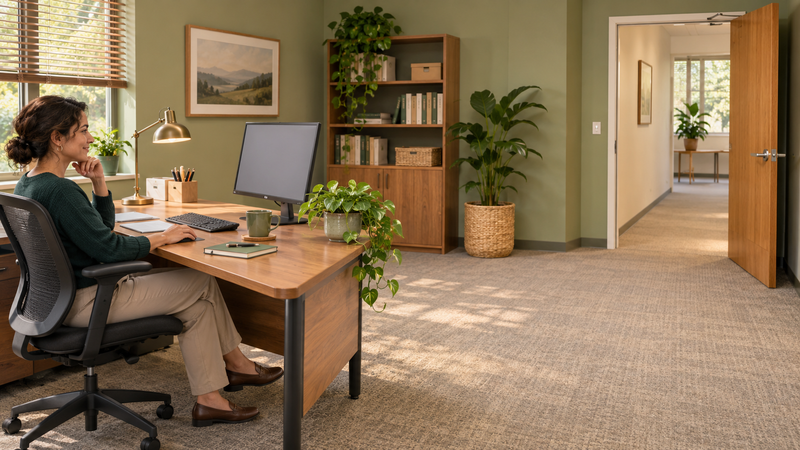
Check the seated view without putting the desk in the doorway
Sit where you normally work and have another person approach at an ordinary pace. Can you notice their arrival without repeatedly turning your whole body? Does the open door hit your chair? Does moving the desk to improve the view put its corner in the route? Make a small trial adjustment and check all three questions again.
Seeing the door and facing directly into its path are different arrangements. If that distinction is your main issue, use the separate desk-facing-door guide. Here, the useful outcome is an entrance you can use comfortably while the room still works for other people.
Also check the screen after any move. OSHA’s workstation environment guidance discusses controlling glare and positioning equipment relative to light sources. A doorway view is not an improvement if it makes you lean around a reflection to read. The office-lighting guide covers that separate check.
Choose an open or closed door for the actual activity
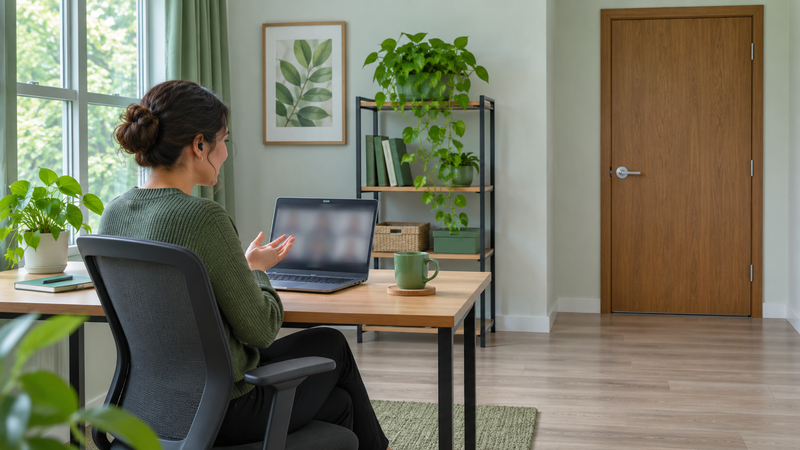
An open door may make informal visits easier, while a private call may require a different arrangement. Agree on a simple signal with colleagues or household members: for example, when interruptions are welcome and when someone should knock. That is a proposed working agreement, not a rule that an office door must always stay open or shut for good luck.
Look through the doorway from the visitor’s side before changing anything permanent. If the view exposes a screen, consider its angle and what is displayed. A freestanding privacy screen can introduce another obstruction, so test any proposed location against the opening arc and the usable route. In rented or shared space, obtain permission for fixtures, films, signs and hardware changes.
Review one change before adding decorations
Start with the conflict you identified. If deliveries collect behind the door, establish a proper delivery spot. If the chair blocks the leaf, try a furniture adjustment. If the issue is interruption, agree on door use. These responses address different causes; a mirror or decorative object does not substitute for them.
After a normal working session, check the approach, opening arc and seated view again, including with a visitor chair in use. Keep a change that resolves the original problem without creating another one. You can then choose modest decoration for preference and identity, provided it remains secure, permitted and outside required routes. There is no need to buy a symbolic “cure” for a problem the room no longer has.
Questions about office doors
Must an office door always stay open for feng shui?
No universal open-door rule is established by the sources used here. Choose room use according to privacy, the building’s requirements and other occupants; do not defeat a closer or latch to maintain a symbolic preference.
Should the desk sit directly in front of the door?
Check the actual layout. Doorway visibility does not require putting furniture in the opening arc or passage. Compare access, seated comfort, privacy and screen glare before keeping a desk position.
Can changing the office door guarantee career luck?
No. Even the Feng Shui Society’s overview rejects guarantees of wealth, health or happiness. Describe practical changes in terms of the conditions you observed, not a promised career or business outcome.