Feng shui office mirrors are often suggested when a desk cannot be moved and the person working there cannot see the entrance. Before adding one, decide what you want to see in it. A useful reflected view, comfortable light and an unobstructed workspace are things you can check. A mirror is not evidence of a future promotion or higher income.
This guide focuses on the mirror itself: its view from the chair, its interaction with light and screens, and its installation. The room examples are illustrative planning exercises, not client case studies or measured productivity results.
Identify the feng shui idea and its limits
In her home-office design explanation, practitioner Anjie Cho describes the commanding position as being able to see the room’s door without sitting directly in line with it. When the desk cannot be arranged that way, she suggests a mirror that makes the door visible from the chair.
That is an attributed feng shui interpretation. It does not establish that a reflected doorway causes career success. Nor does it mean every office needs a mirror. If you already have a comfortable view of the entrance, adding more reflected movement may solve no problem at all.
For the broader desk arrangement, use our office desk placement guide. Here, keep the question narrower: what would this particular mirror add to your existing view?
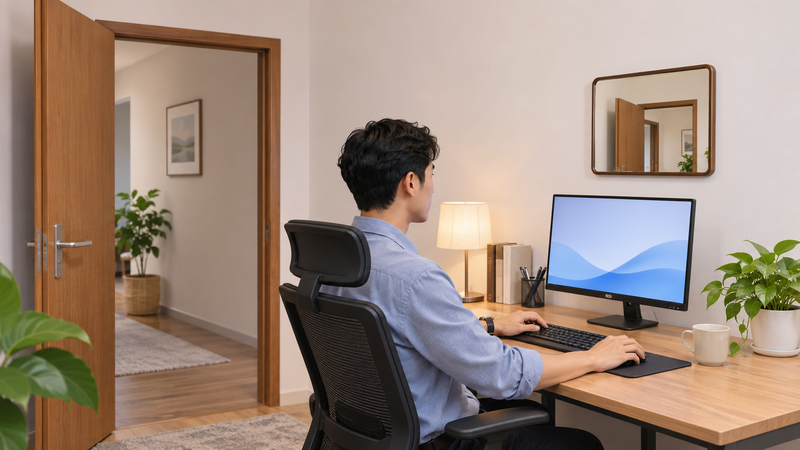
How to check the reflection from your working position
Sit at the desk in the position you normally use. Look at the proposed mirror location without stretching or turning the chair. If checking a small existing mirror, support it securely; do not balance heavy glass on books or a monitor.
Ask another person to stand at the doorway while you check the reflected view. Then reverse the test: stand at the doorway and look back toward the desk and mirror. This is our practical sightline check. It helps you notice what the reflection reveals from both positions; it is not a formal privacy or security assessment.
Swipe or scroll horizontally to see all columns.
| What appears in the mirror? | Question to ask | Possible next step |
|---|---|---|
| The entrance you wanted to see | Is it visible while you sit normally? | Keep evaluating light, privacy and mounting |
| A bright window or lamp | Does it create a distracting bright reflection? | Try a different angle or location |
| A screen or paperwork | Can someone elsewhere read information through the reflection? | Change the view, remove the mirror or use the workplace’s approved privacy measures |
| A colleague’s seat | Is the reflected view welcome in a shared room? | Discuss it before installing anything |
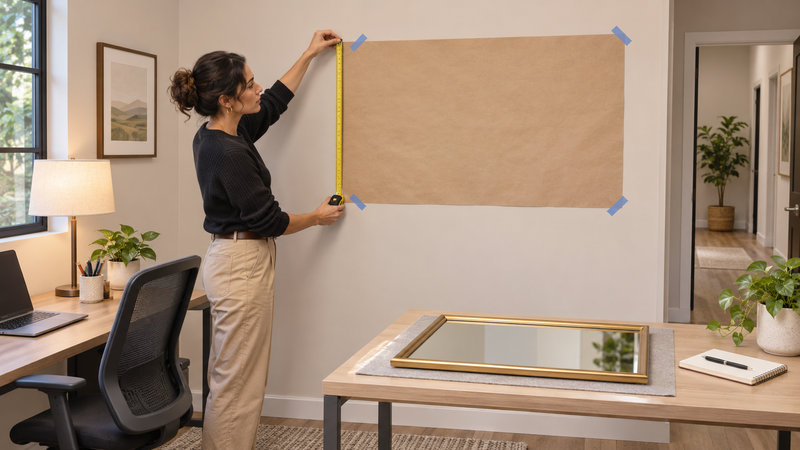
For a rented workstation, a paper rectangle can help you judge size and wall position before purchasing glass, although paper cannot test a reflection. If the proposed spot only works when you lean sideways, reconsider it rather than building a daily habit around an awkward view.
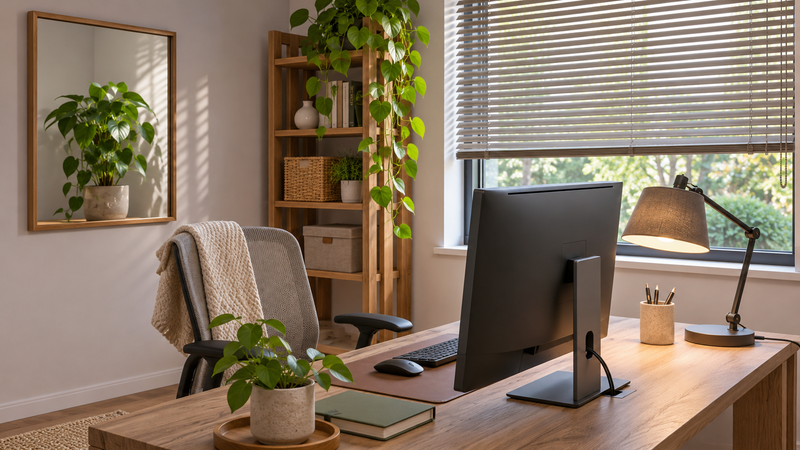
Test glare at different times of day
OSHA’s computer-workstation environment guidance addresses glare from windows, lighting and reflective surfaces. It recommends arranging the workstation to limit reflected glare, using suitable blinds or diffused light, and keeping the screen at right angles to windows where practical.
Those are workstation recommendations, not proof of a feng shui mechanism. Apply them to the whole setup. Do not improve the mirror’s view by moving the monitor into a bright reflection or forcing yourself to sit at an uncomfortable angle.
Check the room during the hours you actually work, with the usual desk lamp switched on and the blinds in their normal position. A photograph taken on one cloudy morning is not enough to judge an afternoon reflection. If the mirror repeatedly adds glare, relocate it or leave it out. Our office lighting checks address that separate lighting problem in more detail.
Check permission and mounting before installation
In a shared or rented office, confirm who may attach objects to the wall and who is responsible for the installation. Keep the mirror out of the chair’s movement, door swing and walking route. A good-looking placement in a photograph does not tell you whether the wall or fixings can support it.
Follow the instructions for the exact mirror. For example, IKEA’s HOVET safety instructions require wall anchoring even when that model stands tilted on the floor, and specify fasteners suitable for the wall material. That is a product-specific example, not permission to use the same hardware for every mirror.
If the product instructions, wall construction or permitted mounting method are unclear, ask the responsible installer or facilities team before putting up the mirror. Do not treat adhesive strips as a universal substitute for the manufacturer’s mounting system.
Review one change before adding more
After a safe installation, use the workstation normally and check the original purpose again. Can you see the entrance comfortably? Has a reflection exposed information or distracted someone? Does the mirror still work with afternoon light? Record those observations instead of judging the change from sales, luck or a single good workday.
A valid outcome is to keep one useful mirror, choose another location, or have no mirror. The point of this exercise is a deliberate choice about a real reflected view. Symbolic meaning can remain a personal preference while comfort, privacy and installation are checked on their own terms.