Feng shui for leadership is most useful as a question about how a leader occupies a room: can you see the people and information you need, welcome a conversation, and leave others enough space to participate? Choose the seat around the meeting’s purpose. A team briefing, a private one-to-one and a hybrid discussion can need different arrangements; a prominent chair does not establish the quality of the decisions made there.
This guide uses a contemporary practitioner’s explanation of the command position as one perspective, then checks the arrangement against the practical demands of a meeting. It does not calculate a personal lucky direction or claim that a room creates authority, promotions or trust. The examples are proposed layouts, not client cases or measured leadership results. If you are arranging a shared office, begin with the room’s existing rules and participants’ needs. The leader’s preferred view is one part of that decision, not the only view that matters.

What the command position means in this discussion
A Singapore Public Service Division feature with practitioner Cliff Tan describes the command position in terms of where someone sits in a room or at a table. It discusses entrance views, traffic and support behind the seat. For meeting rooms, it associates the end of an elongated table with attention and room visibility, while describing round tables as a different setting for less hierarchical conversation.
Those are a practitioner’s interpretations reported in an interview feature, not a controlled study showing that one chair produces better leaders. The same feature says feng shui cannot guarantee a particular outcome. Use its ideas to examine a room, and keep any traditional or symbolic interpretation separate from what you can directly observe.
For example, “I can see the entrance without twisting around” describes a view. “This seat will make the team respect me” predicts other people’s behavior and goes beyond that observation. The first statement can guide a practical adjustment without requiring the second. You can also prefer a supported back or a calmer position without treating that preference as a rule everyone must follow.
Choose a seat for three meeting scenarios
| Meeting scenario | Seat or arrangement to consider | Practical check | Limit of the seating choice |
|---|---|---|---|
| Short team briefing | A facilitator position with a usable view of people and the shared board | Can participants see the information without looking through the facilitator? | Visibility does not prove that the briefing is clear or decisions are sound |
| Private one-to-one | Two usable seats around a small table, with a natural conversation angle | Can each person reach their seat and leave without an awkward obstruction? | A round table does not guarantee trust or confidentiality |
| Hybrid discussion | A position that keeps the leader, participants, camera and shared information usable together | Check remote audio, captions and views as well as the in-room seats | The most prominent in-room seat may not serve remote participants |
Read the table as a set of choices to inspect, not a list of three universally correct layouts. A room’s dimensions, furniture and equipment may rule out an attractive drawing. Ask what the leader must do during this particular meeting: explain, listen, facilitate, decide or share material. One person may need different positions for different parts of the work.
For a briefing, make the information easy to follow
A seat at the end of a long table can be a useful starting position when you need to address everyone. Try it against the actual board or display, however. If you must sit directly in front of the information, others may have a worse view even while you have a good view of the room. Moving slightly to one side or standing beside the board for a brief explanation may suit that task better.
Check the entrance and the ordinary movement route at the same time. A chair that has to be pushed into a doorway whenever someone arrives is a poor working arrangement. A symbolic preference for a commanding view should not require the group to navigate around the leader’s chair, cables or equipment.
In an imagined project briefing, place a blank agenda sheet where every participant can inspect it, then sit in the proposed seats yourself. Look toward the presenter and the shared material from each position. This is a preparation exercise, not a test proving a feng shui effect. If someone’s view is blocked, change the arrangement before deciding that a prominent seat is the right one.
For a one-to-one, inspect both sides of the conversation
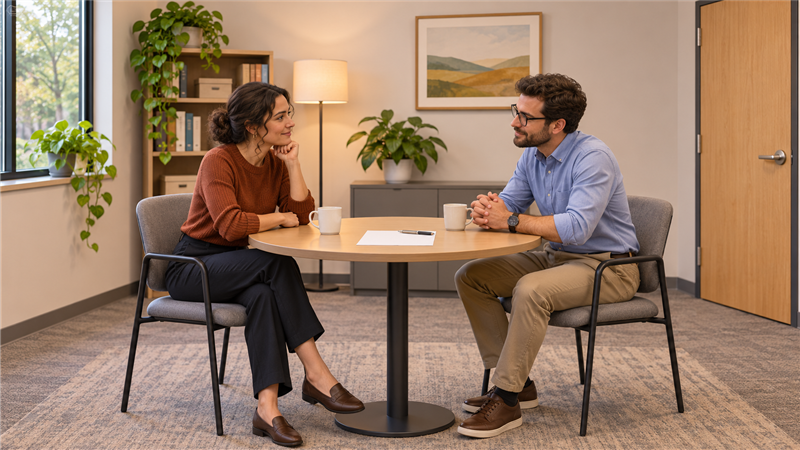
A small round table is one option discussed in Tan’s meeting-room account. Two seats at a suitable angle can also let people look at each other and a shared document without a large desk becoming the center of the encounter. The aim is a usable conversation, not a promise that furniture removes an existing power difference.
Take the other person’s seat before settling on your own. Check whether a bright window is directly behind you, whether a screen dominates the conversation, and whether the person has enough room for their usual access needs. Do not infer those needs from appearances; ask about any adjustments that would help.
Privacy needs a separate check. A door view may be convenient for the leader while leaving a sensitive document visible from the corridor. Position papers and screens for the intended participants and use the organization’s normal information-handling practices. A closed door or a particular table shape does not by itself establish confidentiality.
For a hybrid meeting, include people beyond the room
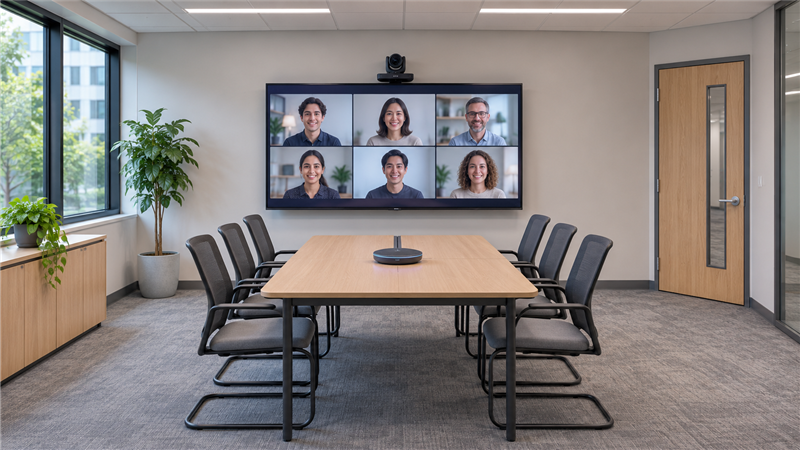
The W3C WAI checklist for accessible events and meetings asks organizers to consider the venue, remote platform, sound, visibility and participants’ accessibility requirements. Those checks are useful when a leader chooses a position: the room arrangement should help people receive and contribute information, including those joining remotely.
Test the actual camera and microphone from the proposed seats. Can a remote participant hear a comment from the far end of the table? Can in-room participants see captions or an interpreter when those are used? Can everyone follow the relevant material without depending on a gesture that remote participants cannot see? Make these questions part of meeting preparation rather than assuming that a good-looking room serves every participant.
A leader using a laptop for the call also needs a workable screen position. OSHA’s monitor guidance considers placement together with the keyboard, desk and chair, and addresses direct viewing and glare. If the proposed “best” seat requires sustained twisting to read the screen, revise the equipment or the seat. That is an ergonomic check, not evidence for a favorable compass direction.
Keep the decision specific: “this position lets me facilitate while everyone can see the board” is a more useful conclusion than “this chair improves leadership.” Our shared-office layout guide addresses a different task, and the office door guide looks more closely at access and door movement. Neither substitutes for asking the people who use the room what works for them.
Questions about feng shui and leadership spaces
Must a leader always sit at the head of the table?
No. An end position can suit some briefings, but the meeting’s purpose, participants, shared information and equipment should guide the choice. A prominent seat does not establish good leadership.
Does a round table guarantee a more trusting conversation?
No. It is one arrangement to consider for a one-to-one. Check both seats, privacy and access, and do not treat a furniture shape as proof of trust or equal power.
Does a command position guarantee stronger leadership?
The practitioner feature cited here does not establish that. It presents an arrangement framework and says feng shui cannot guarantee a particular outcome; practical visibility and access checks are separate observations.
Should the leader’s door view take priority over remote participants?
No. In a hybrid meeting, inspect audio, captions, camera views and shared material as well as in-room sightlines. Choose a usable meeting arrangement for the participants rather than optimizing one seat alone.