Feng shui office cures can mean a practical change to a room, a symbolic object, or a recommendation tied to a particular feng shui method. Identify which kind of proposal you are considering before deciding what to do. A blind that reduces a screen reflection and an ornament chosen for personal meaning have different jobs. Calling both a “cure” does not give them the same evidence or make them medical treatments.
The useful first question is specific: what problem would this change address? If you cannot name it, another object may only make the desk harder to use. If you can name it—such as a reflected lamp or a chair blocking a drawer—you can look for a change that addresses that condition. This guide compares types of recommendations before a decision; it is not a list of objects promised to improve wealth or a repeat of a desk-direction tutorial.
Compare an office adjustment with a symbolic cure
| Proposal | Question to ask | What you can check | Limit |
|---|---|---|---|
| Change a lamp, blind or equipment position | Which visible work problem does it address? | Reflection, view of the task and available working space | A practical improvement does not demonstrate a lucky direction |
| Add an object with personal meaning | Why this object, and where will it fit? | Whether you like it and can work around it | Preference does not establish an effect on income or health |
| Follow an elemental or method-specific remedy | Which method and assumptions produce the recommendation? | Whether the explanation is clear and consistent with the chosen method | Consistency within a tradition is different from evidence of an external outcome |
This is an editorial comparison for evaluating a proposal, not an official classification of every feng shui school. It helps separate a physical action, a personal interpretation and a method-dependent explanation before they are bundled into one sales claim.
What does “cure” mean in this cultural context?
The International Feng Shui Guild’s Universal Topics describes adjustments and remedies from a historical and informative perspective. Its account includes objects, actions and intentions, and discusses elemental remedies based on the Five Elements. This is a practitioner organisation describing its field’s concepts; it is not a clinical or experimental demonstration that an office object causes a particular life outcome.
That range explains why two sources may use the same word for different recommendations. One may suggest rearranging furniture, while another discusses an object through an elemental interpretation. Ask for the method rather than treating every diagram or direction as interchangeable. If a recommendation depends on a floor plan or orientation, the person giving it should be able to identify the information they used.
You can also choose an object simply because you enjoy it. A small ceramic piece might remind you of a family member or a trip. That is a clear personal reason to display it; it does not need to be converted into an unsupported promise about promotion or profit.
For a physical problem, check the physical arrangement
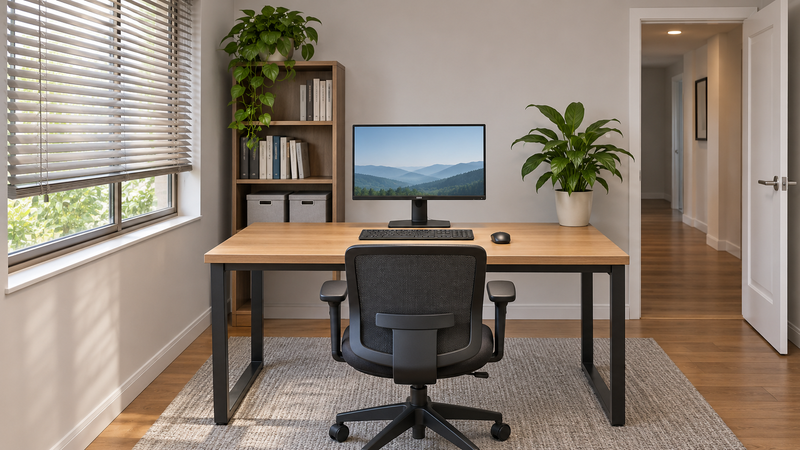
OSHA’s monitor guidance considers the display together with the keyboard, desk and chair. It places the monitor in front of the user for screen-centred work and discusses keeping it perpendicular to windows. Those are workstation considerations, not rules for activating a feng shui sector.
Suppose the screen reflects a bright window. Before adding a mirror or a crystal, inspect the reflection from your normal seated position. A change to the blind or the available screen position addresses the light path directly. OSHA’s workstation environment guidance also discusses blinds and positioning task lights so their light does not reflect on the screen.
Keep the proposed change proportionate to the problem. If a blind adjustment works, you may not need to move the entire desk. If moving equipment makes the keyboard awkward to reach, reconsider the arrangement as a whole. For a detailed check of the reflected view, use our office lighting guide. The purpose here is to choose the right kind of response before choosing its decoration.
Give a symbolic object a clear, ordinary place
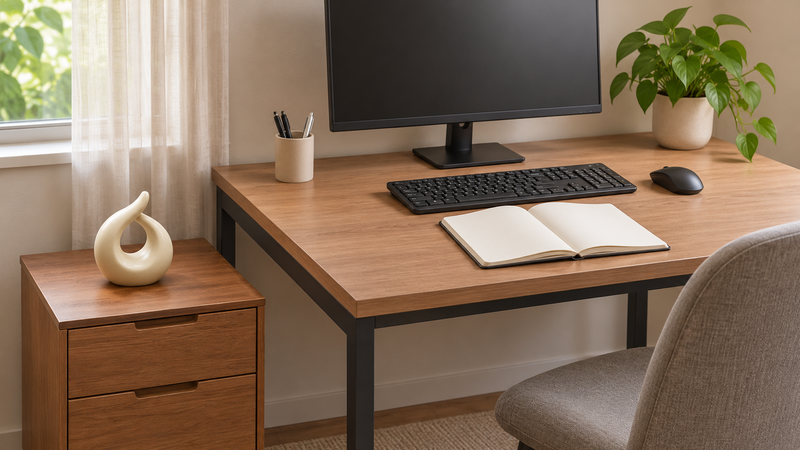
Decide what the object means to you and how much space it needs. Look at the desk while actually working: can the mouse move, can a notebook open, and can the drawer be used? A display area on an existing side cabinet may fit better than the narrow strip in front of the keyboard. This is a layout suggestion to inspect in your own room, not a universal location for every symbolic object.
Consider the object’s ordinary care as well. A plant needs appropriate growing conditions; a water feature adds cleaning and water-handling tasks; a large decorative item occupies real space. Choosing one for a symbolic reason does not remove those practical requirements. Start with something you already own if you simply want to explore a personal display.
In a shared office, discuss a proposed display with the people who use the area. Do not move someone else’s equipment or assign spiritual meanings to their belongings without their agreement. A personal preference can remain personal while the workspace stays usable for others.
Ask for an explanation you can assess
Before agreeing to a proposed cure, write down the concern, the proposed action and the reason offered. Separate the expected physical change from the traditional interpretation. For example: “move the display item to leave room for the notebook” is an observable arrangement claim. “This material represents an element within the chosen method” is a cultural explanation. Neither sentence establishes a future salary result.
The IFSG Code of Ethics asks its members to avoid unsustainable outcome promises, avoid using unsubstantiated fear to pressure clients and ensure that clients understand the recommendations. These are that organisation’s professional expectations, not a guarantee that a particular consultant’s advice is correct.
A clear explanation leaves room for questions and alternatives. If you do not want an object, ask whether a different arrangement serves the same stated purpose. If you cannot move a desk in a workplace, explain that constraint at the beginning. A proposal that depends on an impossible move needs reconsideration, rather than an increasingly elaborate collection of substitutes.

Keep any record modest: what was proposed, what you chose and whether the room remains convenient to use. Our guide to checking one workspace change covers a later question—how to observe an arrangement during work. That is separate from the decision here about what kind of “cure” is being offered.
Questions about feng shui office cures
Is an office cure always an object I need to buy?
No. The term can include actions and adjustments as well as symbolic objects. Begin by identifying the concern and the proposed response; a purchase is not required for every change.
Does an ergonomic recommendation prove a feng shui claim?
No. Guidance about monitor position or glare supports a workstation decision. It does not demonstrate that a compass sector or symbolic material changes income or fortune.
What if I cannot change the furniture?
State that constraint before considering a proposal. Check the smaller adjustments available within the room’s rules, and ask for a clear explanation of any alternative. Do not assume that more objects compensate for an unsuitable plan.