風
fengshuiauspice.com
Quick answer: The most important Feng Shui kitchen no-nos are not decorative. Remove anything combustible from the cooking zone, stay with active cooking, keep a usable route and preparation surface, correct shadows and maintenance problems, and avoid symbolic “cures” that introduce clutter or risk. Cultural preferences can influence how the room feels, but no arrangement guarantees health, wealth or luck.
Many kitchen checklists mix three different things: safety hazards, usability problems and traditional symbolism. Treating them as equal can send attention toward a color or ornament while a towel is still beside the burner. This guide uses a stricter order: protect people first, make the room work second, then consider cultural preferences that do not interfere with either.
Evidence boundary: Fire-safety and kitchen-design sources support the practical checks below. They do not prove that feng shui changes fortune. If a cultural rule conflicts with appliance instructions, fire safety, accessibility or local building requirements, the practical requirement takes priority.
| Priority | Question to ask | Action |
|---|---|---|
| 1. Safety | Could this burn, trip, block or injure someone? | Correct it before adding decor. |
| 2. Function | Can people prepare food, clean and move without awkward workarounds? | Clear the route and work zones. |
| 3. Maintenance | Is dirt, damage or poor light being relabeled as “bad energy”? | Clean, repair or improve visibility. |
| 4. Symbolism | Is the preference optional and harmless? | Use it only if it suits the household. |
Dish towels, paper packaging, loose potholders and similar items do not belong where they can contact heat. The U.S. Consumer Product Safety Commission advises keeping curtains, towels and pot holders away from hot surfaces, while the National Fire Protection Association likewise warns against combustible items around cooking equipment. This is a direct safety issue, not an “element imbalance.”
Turn the cooking appliance off and let the cooking zone cool before checking for combustible items. Move towels, paper and other items that can burn away from heat, pan handles and controls. Follow the appliance manufacturer’s clearance and installation instructions rather than an invented universal distance.
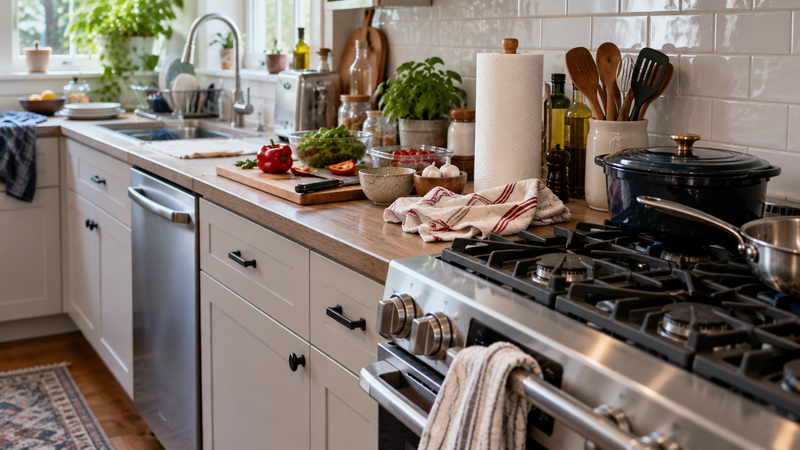
A visually calm kitchen is not safe if cooking is left without attention. CPSC says to stay in the kitchen and keep an eye on cooking; NFPA’s educational guidance is especially direct for frying, boiling, grilling and broiling. A timer can support attention for longer tasks, but it does not replace supervision where the cooking method requires it.
Also turn pan handles away from the counter edge when appropriate, keep children and pets out of the immediate hot zone, and know the emergency guidance for your appliance and location. This article does not substitute for fire-service instructions.
Grease buildup, a loose handle, a leaking fitting or a damaged power cord needs ordinary cleaning or qualified repair. Stop using a damaged or suspect appliance and keep it out of service until a qualified person has inspected it under the manufacturer’s instructions and applicable site procedures. Calling it stagnant qi does not diagnose the cause. Never disguise a defect with fabric, plants or ornaments, and do not attempt gas, electrical, ventilation or structural work without the appropriate competence.
Make a short maintenance list. Separate what the household can safely clean or tighten under the manufacturer’s instructions from what needs a landlord, technician or qualified trade. The outcome should be observable: the surface is clean, the drawer closes, the light works or the fault has been assessed.
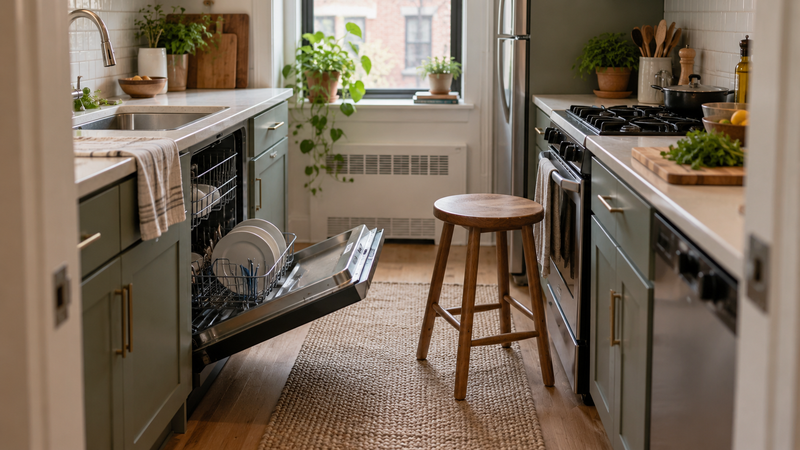
A kitchen may look open in a photograph yet become difficult when the dishwasher, oven, refrigerator or a wide drawer is open. Place stools, bins and movable carts in their normal positions, then test the route while one appliance door is open. Consider the different heights and mobility needs of the people who actually use the space.
The Universal Design Project’s kitchen specifications emphasize usable work areas, appliance access and lighting. Its details are not a universal code for every home, but they reinforce an important method: evaluate the room in use, not as an empty floor plan. Our kitchen layout guide applies that method to zones and walking paths.
A counter covered by appliances, mail and decorative objects forces chopping and serving into whatever gap remains. Choose one realistic preparation area and protect it from storage creep. It need not be large; it needs to be stable, reachable and suitable for the task.
Move occasional appliances elsewhere if the household truly uses them occasionally. Group frequently used tools near the relevant zone without crowding the work surface. The kitchen storage guide can help distinguish daily-access storage from display.
A bright ceiling does not guarantee a visible cutting board. Stand where preparation happens after dark and see whether your head or shoulders shade the work. Also look for reflections from polished surfaces and exposed light sources. Correcting the position or shielding of task light is more useful than choosing a bulb color only because a chart associates it with an element.
Use the kitchen lighting walkthrough to test the counter from the user’s viewpoint. Fixed electrical changes and fixtures near heat or water need to follow product instructions and local requirements.
“Everything visible” and “everything hidden” are both poor absolute rules. Open shelves can work when objects are stable and easy to clean; closed cabinets can work when contents remain accessible. The no-no is storage that blocks controls, narrows the path, overloads a shelf or makes everyday items hard to retrieve.
Review one zone at a time. Remove expired or unused items, relocate duplicates, and keep heavy objects where lifting is controlled. Do not buy organizing products until you know what must remain in that zone.
A plant that blocks light, a mirror that produces distracting glare, or fabric hung near heat is not an improvement simply because it is called a cure. The same applies to bowls, crystals, coins or red objects that consume the preparation area. Optional symbolism should fit around safe use, not replace it.
If you enjoy a traditional object, give it a stable location away from heat, water and work surfaces. Check the care and toxicity needs of plants when children or pets are present. A restrained choice is easier to maintain than a collection of remedies added for every conflicting rule found online.
No front-door direction, stove position, color or ornament can promise wealth, health or family harmony. Traditional feng shui contains multiple schools and interpretive methods; a simplified internet rule should not be treated as a measurable cause of future events.
Use claims carefully. “This arrangement keeps the path clear” is observable. “This arrangement will bring money” is not a result this page can substantiate. If the household values cultural symbolism, describe it as a preference or tradition and keep the practical outcome separate.
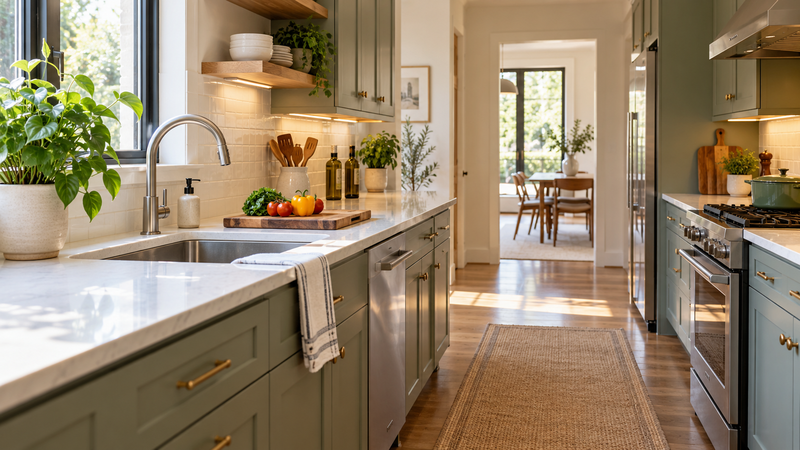
No automatic outcome follows from proximity alone. Check manufacturer clearances, splash, heat, work surface and how people move between the zones. If the arrangement is safe and usable, a symbolic preference should be described as optional rather than a proven hazard.
Only if you like it and it does not crowd the work area. Red decor is not a substitute for cooking safety, lighting, maintenance or a clear route.
No. The plant needs suitable light and care, a stable position, and appropriate consideration for children and pets. It should not block a window, control, walkway or preparation area.
No reliable luck outcome can be promised. The defensible benefits are practical: fewer hazards, clearer movement, more usable work space and easier maintenance.
Practical claims were checked October 29, 2026 against the CPSC safer-cooking guide, the NFPA educational messages reference and the Universal Design Project kitchen specifications. The priority framework and cultural interpretation are editorial. These sources do not validate fortune claims.
Get a detailed feng shui report based on your zodiac, birth year and space layout.
View PackagesPowered by Shanyue Group | Contact: contact@shanyuegroup.com
About | Contact | Privacy Policy
© 2026 Shanyue Group • All Rights Reserved