風
fengshuiauspice.com
Quick answer: For Feng Shui kitchen lighting, begin with the work surface: can you see the preparation area without your body casting a shadow across it? Combine comfortable room lighting with suitable task light, shield distracting glare and keep the counter usable. A softer evening setting is useful after cooking, but it should not make food preparation harder to see.
Here, “balance” is a practical design brief for a room that feels orderly and works well. It is not a measured energy mechanism or a promise about luck. The lighting recommendations below come from residential lighting and universal-design guidance; they do not establish scientific proof for feng shui claims.
You can begin with an observation exercise before buying fixtures. Use the kitchen as you normally would, in the position where you wash, chop and read labels. The important view is the user’s view at the counter, rather than the photograph taken from the doorway.
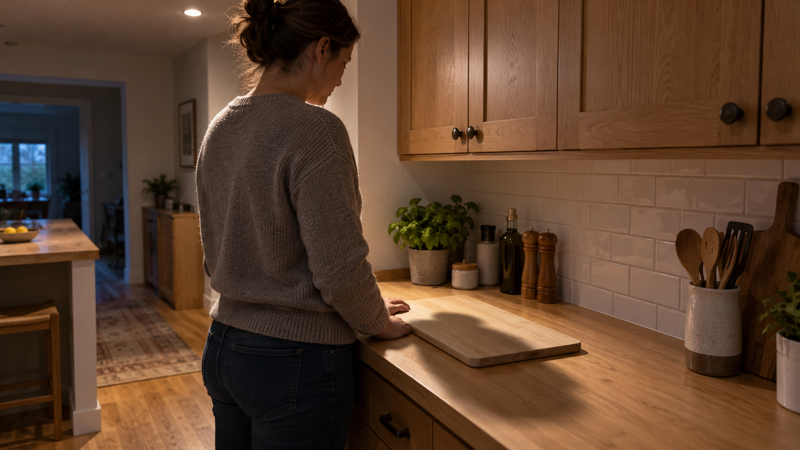
After dark, switch on the lights you normally use. Place an empty cutting board in the preparation area, stand in your usual position and notice where your head, shoulders and hands cast shadows. Repeat at the sink and any second work zone. Make a small sketch showing the existing sources and the locations that remain difficult to see.
The UD Project’s kitchen specifications recommend task lighting at workspaces and explain how a single overhead source can put a person’s shadow on the work area. If the ceiling light is behind you, simply choosing a brighter bulb in that same position may leave the basic shadow problem unresolved.
Also check whether objects on the counter are blocking the light you already have. A tall appliance or a row of containers can create its own dark pocket. Move an item temporarily and repeat the observation. For a broader arrangement change, the kitchen layout guide can help separate work zones from passage space.
Room lighting makes the kitchen broadly legible. Task lighting directs useful light toward a specific job. A decorative pendant may contribute to either, but its appearance alone does not tell you whether the counter is adequately lit.
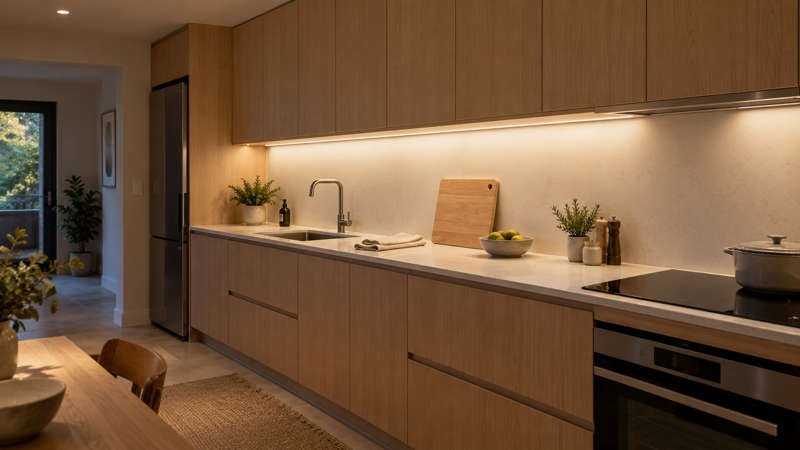
Australia’s Your Home lighting guidance treats room illumination and task illumination separately. For a counter below wall cabinets, a properly selected undercabinet fixture is one possible way to bring light closer to the work. The illustrations below do not establish whether the light sources are shielded. At the actual installation, check normal standing and seated viewpoints for direct and reflected glare.
| Observation | Next check | Possible response |
|---|---|---|
| Your body shades the board | Is the only source behind you? | Assess directed task light near the work zone. |
| The board is bright but the room feels harsh | Are exposed sources or large brightness contrasts visible? | Review shielding and independently controlled room light. |
| A shiny counter reflects the source into your eyes | Does the reflection move when you change viewpoint? | Review fixture position, diffusion and the reflective surface. |
| The room looks fine by day but dim after dark | Was daylight masking an evening gap? | Repeat the counter check without daylight. |
Before replacing a lamp, record the fitting type, physical size and compatible controls. The government’s Energy Rating lamp guide distinguishes lumens, the light output, from watts, the electrical power used. A lower-wattage replacement is not automatically brighter or dimmer; compare the actual specifications.
Color temperature describes the shade of white light, while color rendering describes how colors appear under it. Neither tells you where the light lands. Avoid choosing a supposedly “lucky” color temperature in place of checking visibility, appearance and comfort in the actual kitchen.
If dimming is part of the plan, check the lamp, driver and control compatibility identified by the manufacturer. There is no single bulb count or color-temperature number that suits every room size, cabinet arrangement and user. For fixed-wiring changes or uncertain suitability near water and heat, use an appropriately qualified installer and follow the fixture instructions.
Aim to reduce the distracting bright source or reflection, rather than lowering every light until the work area becomes hard to see. Your Home specifically cautions about direct sun on polished kitchen benches. A suitable shade or blind can soften that light, while task illumination can still serve the preparation zone.
Check shiny backsplash tiles, polished appliances and the counter from your actual eye position. Try changing the shade setting or a permitted adjustable fixture position, then look again. A diffuser or shield may be useful, but choose a product designed for the fitting; do not improvise a cover around a hot lamp.
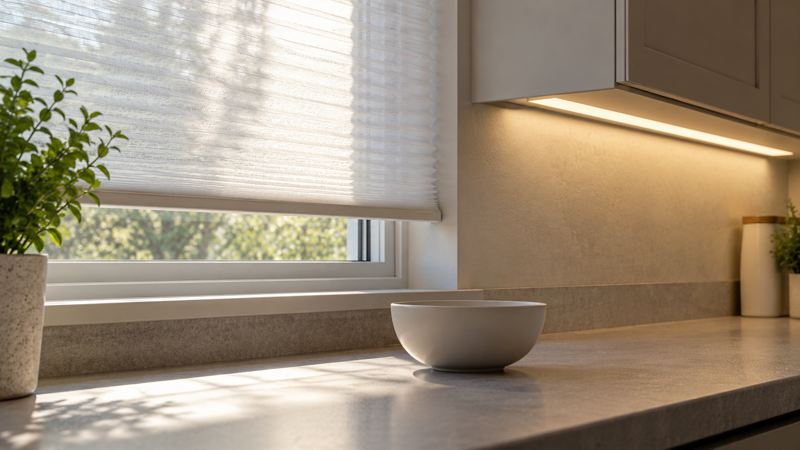
The outcome to record is observable: the counter is easier to see, the reflection is less distracting, or a control is easier to reach. If none of those changed, review the placement before adding decoration. Use kitchen storage planning to keep tall objects from creeping back into the useful light or work area.
No. Choose the appearance you prefer while checking task visibility and color rendering. Color temperature alone does not resolve shadows or glare.
There is no universal count. Identify each work zone and circulation area, then assess whether the fixture positions and output serve those uses.
Only if the work remains clearly visible. Separate task and room controls can let you adjust the atmosphere without sacrificing preparation light.
No reliable outcome can be promised. Evaluate this change by practical visibility, comfort and usability, rather than financial or personal fortune.
Lighting facts were checked October 28, 2026 against Your Home, Energy Rating and the UD Project kitchen specifications. The walkthrough and troubleshooting order are editorial suggestions. These sources support lighting design, not a claim that feng shui controls fortune.
Get a detailed feng shui report based on your zodiac, birth year and space layout.
View PackagesPowered by Shanyue Group | Contact: contact@shanyuegroup.com
About | Contact | Privacy Policy
© 2026 Shanyue Group • All Rights Reserved