風
fengshuiauspice.com
Quick answer
To locate a feng shui living room wealth corner, first choose one mapping convention and one boundary. A popular door-aligned bagua places the area at the rear-left of the living room as viewed from its entrance. A compass-oriented approach uses the southeast sector of the room or home. These are different conventions, so do not overlay both and select whichever corner is easier to decorate.
After locating the area, check the real room before adding anything: keep the walkway open, make sure doors and windows still work, use only stable furniture, and choose a plant or lamp that suits the available light and maintenance. In this article, “wealth corner” describes a traditional and contemporary feng shui framework. It does not guarantee income, luck or investment results.
A wealth corner is a part of a mapped space associated with prosperity in some feng shui traditions and modern bagua practices. The phrase sounds as if every home contains one universally agreed point, but the location depends on the system being used. The boundary also matters: mapping an entire home can identify a different area from mapping only the living room.
For a useful room exercise, separate three questions:
This sequence prevents a symbolic label from overruling the actual room. A mapped corner beside a frequently opened door, for example, should remain usable as a doorway. A dark corner is not improved by placing a light-hungry plant there and allowing it to decline.
Academic writing about feng shui commonly distinguishes approaches that emphasize visible form and environmental configuration from systems that use direction, trigrams and compass analysis. The distinctions are more complex than a short decorating guide can reproduce, but they explain why two instructions may point to different places.
The Virginia Tech thesis discussing feng shui principles describes visual form analysis and compass-oriented analysis as different bodies of practice. A separate academic paper on the Form School approach likewise distinguishes physical configuration from directional calculation.
| Method used in this guide | Reference point | Result to record |
|---|---|---|
| Door-aligned bagua convention | Stand at the living-room entrance and face into the room. | The rear-left area of the defined room. |
| Compass-oriented sector convention | Measure direction consistently for the living room or whole home. | The southeast sector within the chosen boundary. |
Neither row is permission to keep remapping until a preferred shelf becomes the answer. Write down the method and boundary first. If you are following a formal classical calculation, use that system consistently and consult a qualified practitioner for factors beyond a simple room guide. Our broader Bagua map guide explains the mapping concept in more detail.
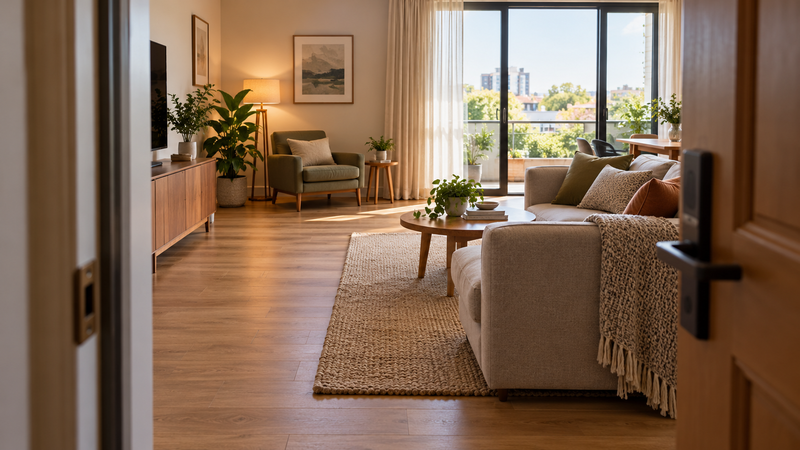
For the doorway-based convention, stand at the main entrance to the living room and look inward. Imagine the room divided into a three-by-three grid. The wealth area is the rear-left portion from that viewing position. A contemporary guide to the feng shui money corner describes this far-left doorway convention while also treating it as a belief and design practice rather than a certain financial mechanism.
Use the actual entrance through which people normally enter the living room. A wide opening can still be treated as the room entrance; mark its center before facing inward. For two equally important openings, choose the primary circulation route and record the choice instead of changing viewpoints during the exercise.
The grid is a planning aid, so an exact tape-marked square is unnecessary. What matters is using the same entrance and room boundary throughout the check.
A compass-oriented convention starts with measured direction rather than the doorway view. Decide whether you are mapping the living room alone or locating the southeast part of the whole home. Those two baselines can produce different results, especially when the living room sits on one side of an irregular floor plan.
Stand in an open part of the chosen space and follow the instructions for a reliable compass. Keep away from large metal objects, speakers and active electronics that may disturb a reading. Take more than one reading from nearby positions. If the readings disagree substantially, resolve the measurement problem before assigning a sector.
Next, sketch the chosen boundary and mark north, east, south and west. Southeast lies between east and south. Identify which portion of the living room falls in that direction, then check its actual use. The compass reading provides orientation; it does not tell you that a doorway must be blocked, a television moved unsafely or useful storage removed.
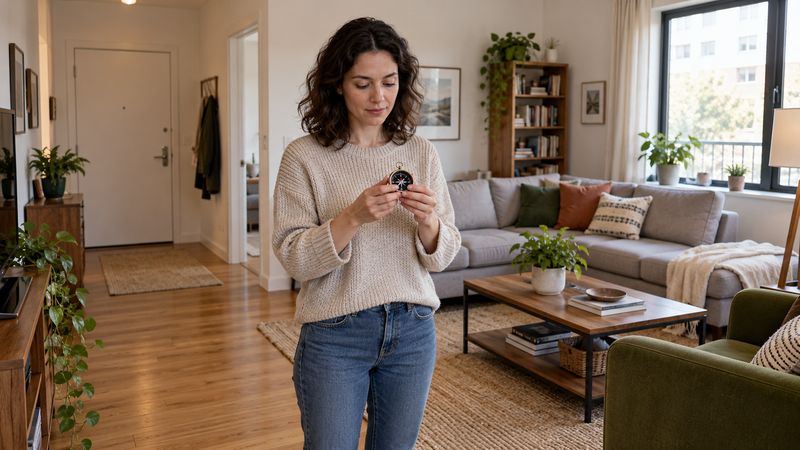
Open-plan homes make the boundary decision more visible. Use fixed architectural cues first: changes in wall line, ceiling height, flooring, lighting zones and the arrangement that defines the seating area. Draw one reasonable living-room boundary and keep it for the entire mapping exercise. Do not redraw it around a convenient plant or empty table.
If the mapped area is a window, doorway, radiator, television zone or busy route, treat that condition as information. You can care for the area without filling it:
When the overall furniture plan is the real problem, work through the feng shui living room layout guide before adding a wealth-focused display.
Begin with maintenance rather than shopping. Remove rubbish and objects that belong elsewhere. Repair a loose handle, clean a neglected surface, and confirm that the route past the corner remains comfortable. These changes are observable and useful even if you treat feng shui only as a way to review a room.
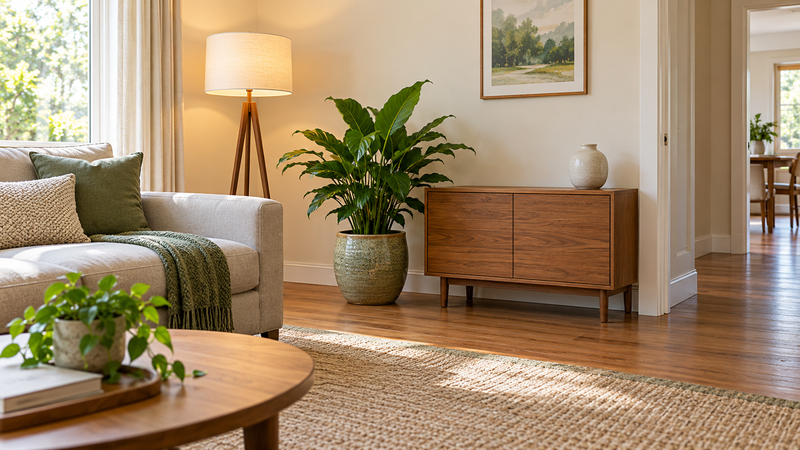
Then choose, at most, one functional improvement and one modest visual focus:
Do not place a fountain where water could damage flooring or reach electrical equipment. Do not add candles or incense simply because a list calls them an “activation.” Safety instructions, building rules and normal household needs come first.
For homes with children, the U.S. Consumer Product Safety Commission’s Anchor It guidance recommends securing top-heavy furniture and televisions and removing items that tempt children to climb. A wealth-corner arrangement should not create a tip-over or climbing hazard.
Feng shui is a traditional practice with multiple lineages and modern adaptations. The practical checks in this article—consistent mapping, usable circulation, stable furniture and maintainable decor—can be observed in the room. A claim that the arrangement causes financial gain is not established by those observations.
No. Southeast is used in a compass-oriented sector convention. A popular door-aligned bagua convention instead identifies the rear-left area from the living-room entrance. Choose the method and boundary before locating the area, and do not present one result as universal across all feng shui systems.
Yes, if you are intentionally using the door-aligned bagua convention. Stand at the living-room entrance, face into the room and identify the rear-left portion of that defined space. Record the entrance you used so the map does not change later.
Keep the window or doorway fully functional. Clean and maintain the area, preserve the route, and use a nearby wall or stable surface for any modest visual focus. Do not block an opening to make the corner look more decorated.
No. A wealth corner is part of a traditional or contemporary feng shui framework, not a guaranteed financial mechanism. Use it as a prompt to care for the room and clarify personal goals, while making financial decisions through appropriate budgeting, professional advice and verified information.
Get a detailed feng shui report based on your zodiac, birth year and space layout.
View PackagesPowered by Shanyue Group | Contact: contact@shanyuegroup.com
About | Contact | Privacy Policy
© 2026 Shanyue Group • All Rights Reserved