風
fengshuiauspice.com
For feng shui living room lighting, start with the activities in the room: enough general light to move around, a focused lamp where someone reads, and adjustable light for conversation or television. Test the view from each seat before buying another lamp.
If you approach decorating through feng shui, use this as a way to review how the room feels and functions. Brightness, shadows, reflections and access to switches are things you can observe. A lamp count or compass direction does not establish that a room will bring wealth or change someone’s fate.
| Activity | First check in the actual room |
|---|---|
| Reading in an armchair | Can the lamp illuminate the page without an exposed bulb in the reader’s view? |
| Conversation and moving around | Can people see one another and the route past the furniture? |
| Watching television | Does a window or lamp reflect in the screen from the sofa? |
The DOE-sponsored High Performance Residential Lighting guide distinguishes ambient light for general use, task light for a particular activity, and accent light for emphasis. Those categories help you ask what a lamp is doing. An attractive accent light may highlight a wall without making a book easier to read.
Make a quick sketch of the doorway, seats, television and existing outlets. Then test the room after daylight fades. Write down one problem at a time—“page in shadow” or “lamp reflected in screen”—so the next change responds to something specific.
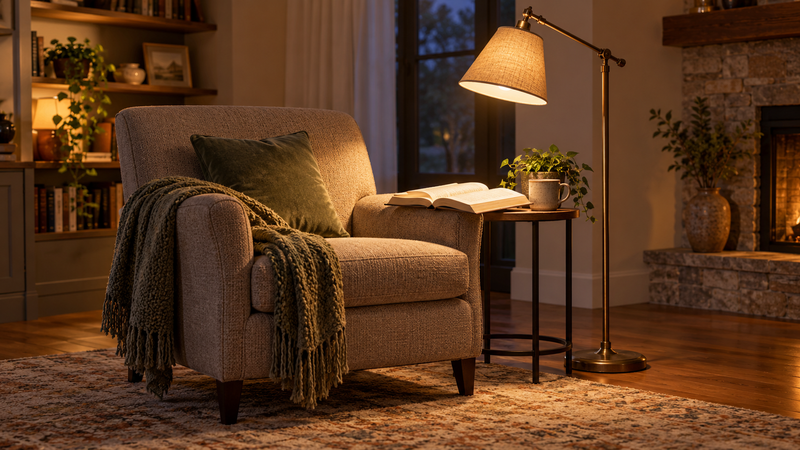
Sit in the chair with the book or craft you normally use. Keep the ceiling light as you would in the evening. Move an existing portable lamp, if you have one, to test whether a different angle lights the task better. Look from your seated position, not just from a standing photograph of the room.
The useful position is one that puts light on the work while keeping the bare source out of the normal sightline. A shade or adjustable head can help you direct the light, but the fixture still needs to suit the chair’s height and the task. Check that your own head or arm is not creating the shadow you are trying to remove.
Before buying, measure the available floor or side-table space and check where the cable would run. A lamp that looks balanced beside the chair can still be awkward if its base occupies the walking route or its switch is hard to reach. Test placement before choosing a larger fixture.
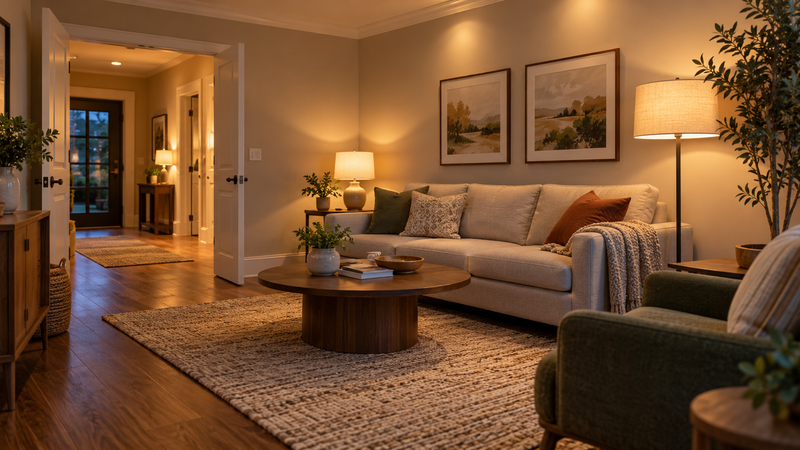
Walk from the doorway to each seat with the lights you normally use. Notice the floor, table edges and changes in level. Then sit facing the other seats. If a single ceiling source leaves faces in shadow, compare a side lamp or a different shade before assuming that the whole room needs a stronger overhead bulb.
For a small living room, begin with the lamps you can actually place and control. You might use general illumination for movement and a separate reading lamp that is switched on only when needed. Decorative wall lighting is optional. More fixtures are useful only if they solve a problem or serve a purpose you value.
Symmetry can be a decorating choice, but matching lamps do not have to be bought as a pair when the two sides of the room serve different activities. Preserve the route around the sofa and coffee table as you test positions. For a brief wider check, use our brief living-room layout checklist.
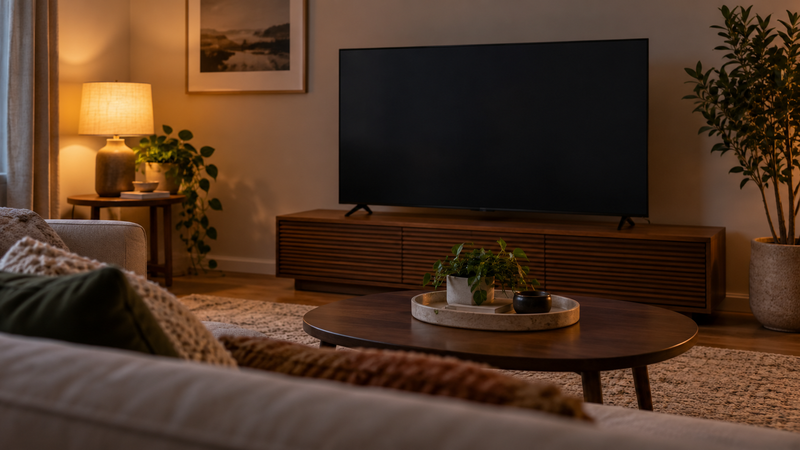
Turn the television off and sit in each usual viewing position. The dark screen makes reflections easier to locate. Turn lamps on one at a time, and check the window in daylight as well. A reflection seen from one seat may not be obvious from another.
If a lamp appears in the screen, try a small change in its position, angle or shade. Adjust a curtain or blind if the reflection comes from the window. Keep some usable room light for moving around; the goal of the trial is to find a workable arrangement, rather than simply turning everything off.
Test again with the television on at your normal setting. Keep cables along a suitable edge rather than across the route to the sofa. If the furniture itself needs to move, use the checks in our living-room TV placement guide before buying a new light to compensate for the layout.
Compare light output in lumens, rather than treating watts as brightness. The FTC’s light-bulb guide explains that watts indicate energy use and that the Lighting Facts label includes brightness and light appearance. Neither a wattage number nor the word “warm” tells you whether your particular reading seat will be adequately lit.
Color temperature describes the appearance of the light. ENERGY STAR’s downlight guidance explains that lower Kelvin values look warmer and higher values whiter or bluer. Compare a sample in your room if possible, especially when it will sit beside existing lights. There is no universal lucky Kelvin setting.
If you want dimming, check the exact lamp, bulb and dimmer combination in the manufacturers’ compatibility information. A dimmable LED is not automatically compatible with every existing switch. Also follow the fixture’s bulb and rating instructions. Fixed wiring or switch changes belong with an appropriately qualified installer; this guide is for planning and placement.
No universal number follows from the room checks here. Choose lighting that serves the actual activities, fits the available space and can be controlled conveniently.
No. Watts indicate energy use. Compare lumens for light output, then consider how the fixture distributes that light where you need it.
No. Warm white describes light appearance. Output, shade, position, surfaces and the task all affect the result in your room.
No. Check the specific manufacturer’s compatibility information for the bulb or fixture and the dimmer. “Dimmable” alone does not establish a working combination.
Get a detailed feng shui report based on your zodiac, birth year and space layout.
View PackagesPowered by Shanyue Group | Contact: contact@shanyuegroup.com
About | Contact | Privacy Policy
© 2026 Shanyue Group • All Rights Reserved