Feng shui for teamwork can be used as a way to examine how a shared workplace supports different activities: handing over work, reviewing something together and concentrating alone. Start with those activities, then consider where each belongs. A room arrangement can make a task easier to carry out; it cannot guarantee that colleagues will cooperate, communicate clearly or trust one another.
This guide uses a contemporary practitioner’s account of workspace feng shui alongside a limited piece of office research. It proposes a shared handoff area and a separate focus setting for a small team. The example is a layout to discuss and test, not a client case or a measured improvement in performance.
The useful question is specific: where can two people review a file without turning everyone else’s desk into a conversation area? That gives the team something observable to work on, rather than asking a decorative object or compass direction to solve a working relationship.
Start with the team’s work scenarios
In a Singapore Public Service Division feature, architect and feng shui practitioner Cliff Tan distinguishes a calmer, lower-traffic setting for focused work from a more conversational setting for work involving connection. That is a contemporary practitioner’s interpretation of arranging a space around its purpose. The same feature says feng shui cannot guarantee a specific outcome.
For a team, apply that distinction to tasks rather than seniority. A colleague may need a shared surface for a morning handoff and a quieter workstation for an afternoon report. Those are different needs within the same working day.
| Work scenario | Setting to consider | Observable check | What the setting cannot establish |
|---|---|---|---|
| Handing over an unfinished task | A small shared surface with the current file and note about the remaining work | Can both people inspect the same material without occupying a third person’s desk? | That the instructions are correct or responsibility has been accepted |
| Brief joint review | A shared board or screen away from individual focus desks | Can the participants see the relevant item without blocking a route? | That agreement has been reached |
| Individual focused work | A workstation outside the regular conversation and handoff area | Can someone work there without routine handoffs happening beside them? | That the space is acoustically private or free from every interruption |
These are proposed settings, not a traditional map assigning a lucky sector to every team function. Use the table to identify one actual difficulty in your room before moving furniture.
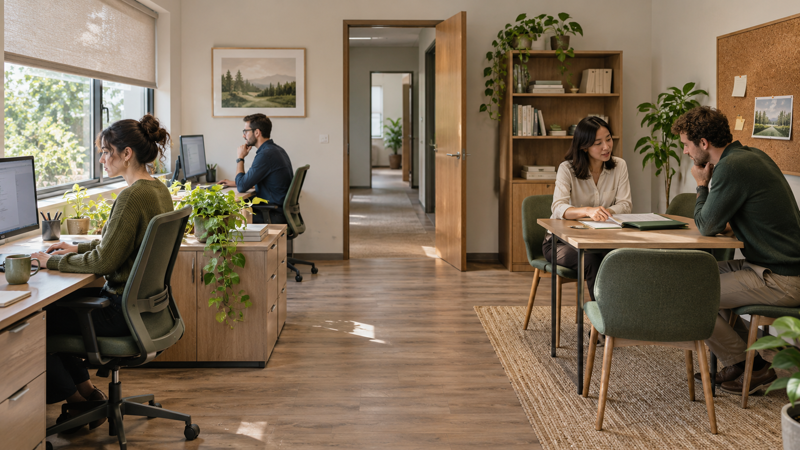
Plan a shared place for handoffs
Choose a surface that belongs to the task, rather than to one person’s status. It might be the end of a shared table, a small side unit or a board with a nearby place for a document. Keep the normal route usable when two colleagues stand there.
In an imagined four-person project team, a handoff surface could hold one current folder and a short note identifying what needs attention next. Before leaving, the receiving person checks which version is current and whether anything remains unclear. The furniture provides a place for that exchange; the people still have to confirm the work.
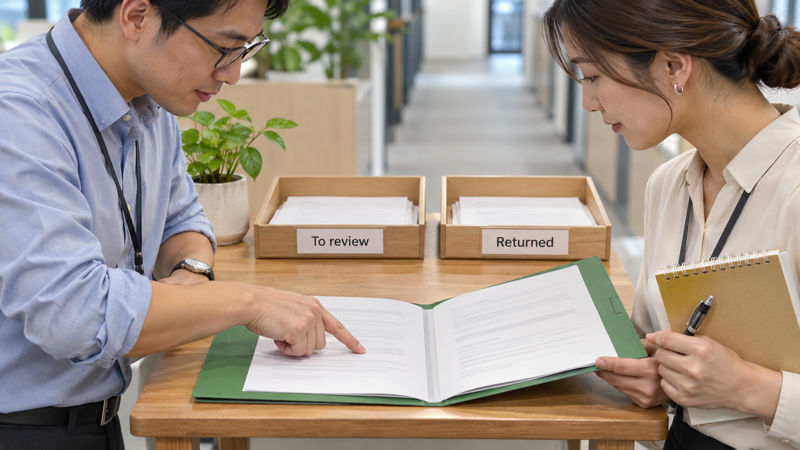
A pair of document trays may help distinguish material awaiting review from material that has been returned, provided the team agrees what each tray means. Do not rely on a colour, a tray or a wall position to communicate an instruction nobody has explained. Sensitive work should continue to follow the organisation’s normal information-handling rules.
For basic desk positions and movement around two workstations, use our two-desk shared-room layout discussion. The additional decision here is where a team exchange should happen once those desks are in use.
Protect a place for focused work
Making every conversation visible is not the same as improving collaboration. In their 2018 paper, Ethan Bernstein and Stephen Turban reported two corporate-headquarters field studies in which face-to-face interaction fell after moves to more open office layouts, while electronic interaction increased.
That finding does not predict what every open office will do, and it was not a test of feng shui. It is a reason to question the assumption that removing spatial boundaries automatically creates more useful conversation. The practical inference for this proposed room is to give shared exchanges a place while preserving somewhere for individual work.
A quiet-looking corner also needs an ordinary workstation check. OSHA’s workstation guidance recommends arranging screens, windows and lighting to reduce glare. Try the proposed seat at the time it will be used. Moving someone away from conversation but into an uncomfortable screen position would exchange one problem for another.
Test the plan with the team
Begin with one reversible change: clear a shared review surface, move a mobile tray or agree where brief handoffs take place. Keep fixed desks, access requirements and the organisation’s workplace rules in view. A useful sketch shows the new activity as well as the furniture.
Ask the people who use the room what happened during normal work. Was the current file easier to find? Did exchanges move away from a colleague’s focus desk, or did the new location create another obstruction? Keep the observation specific. A positive comment about a tidy surface is not evidence that feng shui improved trust or overall productivity.
If the trial is inconvenient, adjust it or put the room back. The team should be able to explain why the arrangement is being kept in terms of the task it serves. For the different question of where a facilitator sits during a briefing or one-to-one, see our guide to meeting-seat choices.

Questions about teamwork and feng shui
Does an open office automatically improve teamwork?
No. Office layout and teamwork are different questions. The two field studies cited here found less face-to-face interaction after greater openness, but they do not establish a universal rule for every office. Check how the actual arrangement serves your team’s tasks.
Should everyone use the same lucky desk direction?
This proposed layout does not calculate personal favourable directions. Start with people’s work, access and viewing needs. A symbolic preference can be discussed, but it should not override another colleague’s usable workstation or be treated as a guarantee of cooperation.