Feng shui office storage is most useful as a question about how a room works: can you find the next file, put it away and move around without squeezing past furniture? Begin with those observable tasks. A cabinet’s direction or colour is not evidence that it will increase income, secure a promotion or change your luck.
This method separates a contemporary feng shui interpretation from ordinary organisation and furniture safety. You can prefer a calm-looking room without claiming that its energy has been measured. Start with what you actually keep, not a photograph of an empty desk. A working office needs records, equipment and supplies; the aim is to give them usable homes rather than hide them somewhere inconvenient.
Step 1: Separate the storage job from a luck claim
A Singapore Public Service Division feature with practitioner Cliff Tan discusses arranging work items for access and movement. It also says feng shui cannot guarantee a specific outcome. That is a useful boundary: you can apply an arrangement idea while judging its practical effect independently.
Describe the actual problem before moving anything. “I leave invoices on the keyboard because their drawer is across the room” is actionable. “This cupboard blocks prosperity” is a belief-based interpretation, not a diagnosis established by the room’s appearance. Fixing the first problem does not prove the second claim.
Step 2: Sort by the next time an item will be used
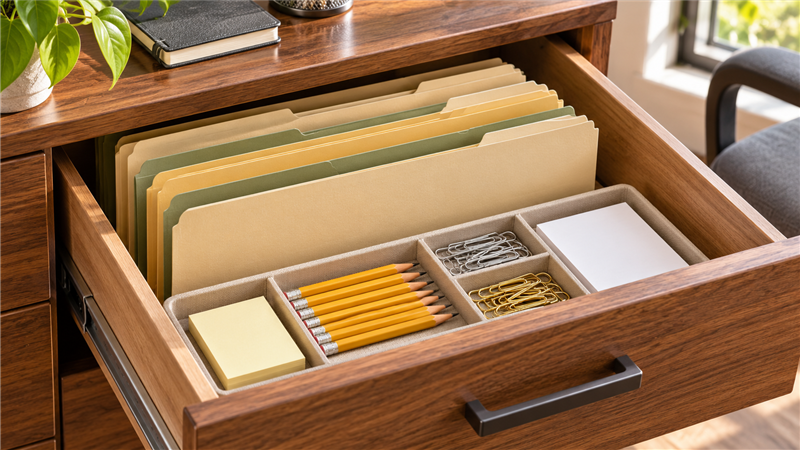
Before buying a container, separate active work, reference material and spare supplies. These are suggested working groups, not a traditional feng shui classification. Change them to match your job. An illustrator’s active materials will differ from a bookkeeper’s paperwork.
| Contents | A possible home | Check before deciding |
|---|---|---|
| Current project folder | A nearby drawer or upright file | Can you retrieve and return it without moving another pile? |
| Occasional reference books | A suitable shelf or cabinet | Can you read the labels and reach safely? |
| Spare paper and supplies | A separate supply shelf | Does it avoid crowding the current task? |
| Confidential records | Storage appropriate to your organisation’s policy | Who can see or access the contents? |
For example, keep a current project folder near the place you use it, but put unused stationery with the rest of the supplies. This is a proposed arrangement to try, not a claim that one distance works for everyone. Keep records for the periods required by the rules that apply to you; a tidy-looking room is not a reason to discard documents indiscriminately.
Step 3: Check the desk and cabinet together
OSHA’s desk guidance says frequently used devices should remain within easy access and stored items should not restrict leg and foot clearance. A storage unit that fits under a desk in a catalogue can still prevent your chair from approaching the keyboard or leave you sitting to one side.
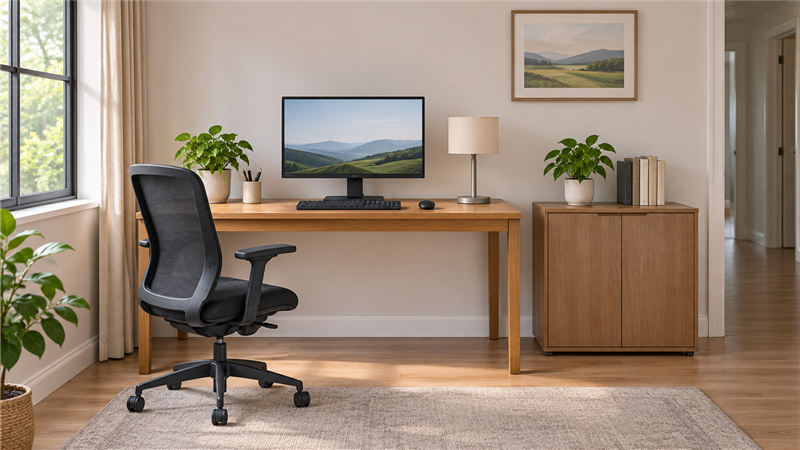
Sit at the desk before filling the drawers. Move the chair as you normally would, place your feet comfortably and reach for the things you use repeatedly. Open the proposed cabinet door: does it interfere with the chair or another person? If a path is already tight, adding an attractive box may make the problem worse.
For the doorway itself, use our office doors guide. Storage should be checked against that existing circulation path rather than used to redesign the whole room around a new cabinet.
Step 4: Choose open or closed storage for the contents
Open shelving makes some objects easy to identify; closed doors can conceal supplies or information from casual view. Neither is automatically better feng shui. Choose according to the contents, the people who use the room and how reliably things will be put back. A closed cabinet is not secure storage merely because its contents are hidden.
Keep furniture stability separate from symbolic interpretations. Health Canada advises following assembly instructions, securing furniture with suitable anti-tip devices and keeping heavier items lower. Drawers can affect stability when open. Follow the manufacturer’s requirements and seek installation help where needed, especially in a home office accessible to children.
Do not put a heavy object high up simply to complete a decorative arrangement. Check the furniture’s rated use and load instructions. A decorative plant, crystal or colour choice does not replace a sound cabinet, appropriate anchoring or a clear route.
Step 5: Test retrieval and put-away
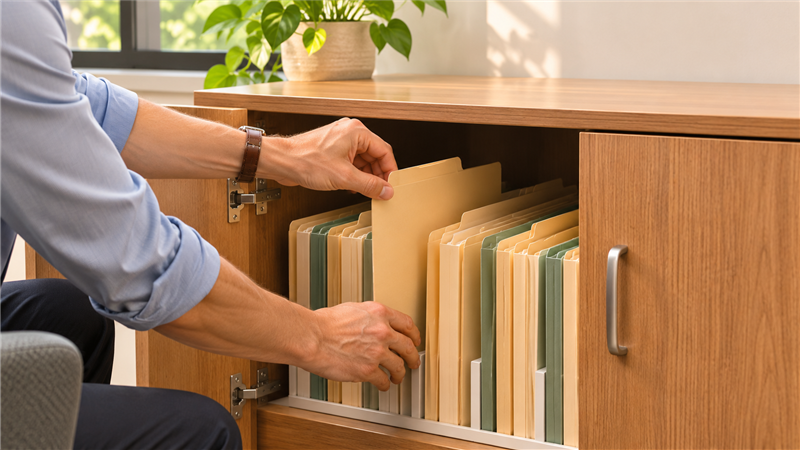
Try one normal work session before buying more storage. Retrieve a current file, use it and return it. Note the specific obstruction if the system fails: an unreadable label, a drawer that cannot open or several unrelated items sharing a container. Adjust that problem rather than interpreting every inconvenience as bad energy.
In a shared room, agree who owns each shelf and where unfinished work belongs. Our shared-office guide addresses competing needs. A successful arrangement here means you can use the space and maintain it; it is not proof of an improvement in health, career or finances.
Questions about office storage
Is there one lucky direction for an office cabinet?
No universal direction is established by the sources used here. Start with access, contents and safety. If you follow a particular feng shui tradition, distinguish that interpretation from a promised or measured result.
Is under-desk storage always a good use of space?
No. It is unsuitable if it restricts legroom, foot space or your chair position. Check the actual seated arrangement instead of relying only on the cabinet’s dimensions.
Can closed doors solve office clutter on their own?
No. Concealing items does not assign them a return place or make them easy to retrieve. Decide what belongs inside and test whether you can use and maintain that arrangement.