風
fengshuiauspice.com
Choose one healthy kitchen plant that fits the room’s real light, humidity and temperature. Place it on a stable surface away from flame, hot grease, food-preparation space and heavy sink splash. In a feng shui reading, living greenery may be used as a Wood-element accent, but no species or compass position guarantees luck, health, wealth or cleaner air.
A “lucky plant” that receives too little light or repeated heat stress soon becomes a struggling plant. The Royal Horticultural Society’s houseplant selection guidance recommends matching a plant to light, humidity and temperature. Kitchens can be more humid than living rooms, but conditions still vary sharply from a bright window to a dark shelf.
Observe the proposed position at breakfast, midday and late afternoon. Note direct sun, cold drafts, oven heat and how often someone opens a cabinet beside it. A care label or reputable species guide should decide whether the plant can live there. Symbolic meaning comes after the growing conditions.
If the room itself has circulation or fixture problems, start with the feng shui kitchen layout guide. A plant should not be used to hide a blocked path, poor task lighting or an unsafe appliance relationship.
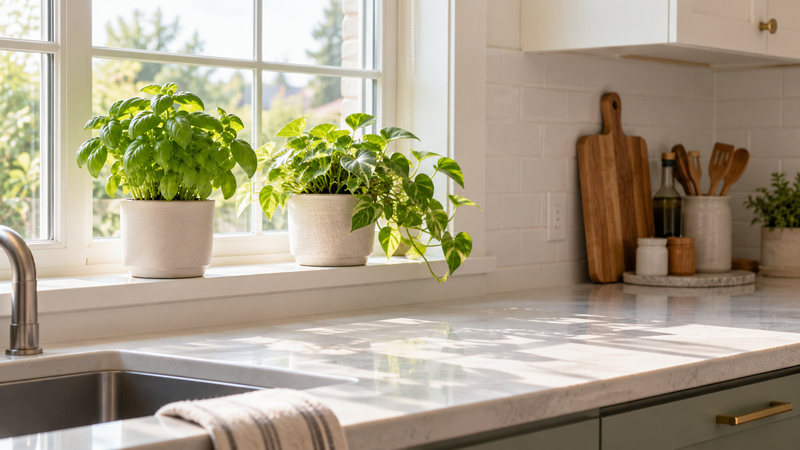
Instead of beginning with a compass direction, mark where cooking actually happens. Keep the stove and its hot-pan landing area clear. Leave the main chopping and plating surface available. Avoid appliance exhaust, refrigerator heat discharge and cabinet doors that could knock a pot down.
A small kitchen may have only one viable plant zone. That is enough. One healthy, well-placed plant creates a clearer visual accent than several stressed plants distributed to satisfy a diagram.
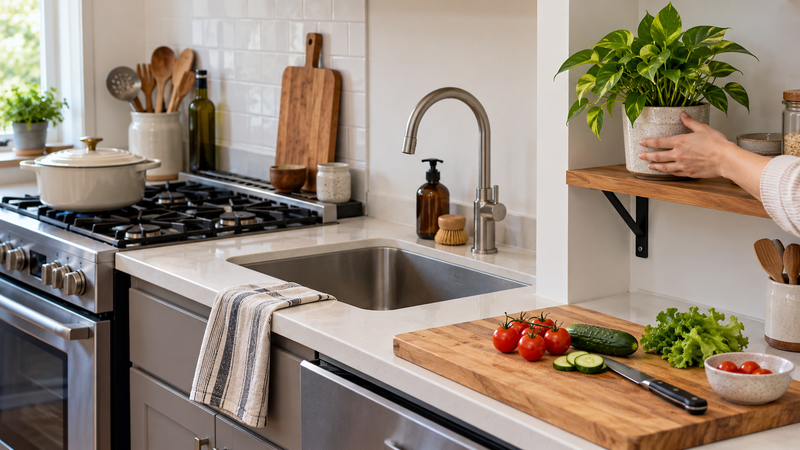
“Low light” does not mean no light. The RHS notes that many plants struggle when set well back from windows and that normal household lighting is not automatically suitable for plant growth. If the kitchen is genuinely dark, a plant in another room may be the better choice.
| Kitchen condition | Useful direction | What to verify | Avoid |
|---|---|---|---|
| Bright window | Compact foliage plant or culinary herb suited to that exposure | Direct-sun tolerance, watering and seasonal heat | Leaves touching hot glass or blocking the work surface |
| Bright, humid area | Species that accepts humidity and stable indirect light | Air movement, drainage and fungal signs | A constantly wet pot or leaves over food |
| Limited natural light | Reconsider the position or use a suitable grow light | Species minimum light requirement | Buying a plant because it is marketed as “no-light” |
| Edible herb pot | Use a clean container with drainage and a clearly identified herb | Light, food-safe care and harvesting guidance | Garden soil indoors or chemical treatments not intended for edible plants |
University of Minnesota Extension guidance for container herbs emphasizes drainage holes. An herb is not automatically easy simply because it belongs in a kitchen; it still needs the right light, water and clean growing setup.
A plant near the stove collects grease and may expose dry leaves, a pot or hanging stems to heat. Keep a clear working and landing zone around the cooking area. Do not hang trailing plants where they can fall into a burner, pan or kettle.
At the sink, occasional humidity may suit some plants, but detergent splash and waterlogged soil do not. Use a saucer that protects the surface, empty standing water and keep soil or fallen leaves away from clean dishes and ready-to-eat food. University of Minnesota Extension’s indoor plant guidance recommends suitable conditions, good drainage and regular inspection to reduce pest problems.
In contemporary feng shui discussions, living green plants are often associated with Wood: growth, flexibility and upward movement. This can be a useful design language when a hard-surfaced kitchen feels visually severe. It is not a scientific effect and not a universal rule shared identically by every feng shui school.
Let the symbolic layer describe what you can see: healthy growth, natural texture and a soft contrast with metal, stone or tile. Do not claim that a money tree produces money, that a direction guarantees opportunity or that an unhealthy plant creates misfortune.
Color can reinforce the visual idea without requiring more plants. The kitchen color guide explains how to compare light, material and household preference instead of relying on one universal “best” shade.
Common names are unreliable because different species may share the same nickname. The ASPCA’s toxic and non-toxic plant database advises identifying the plant and notes that even plant material categorized as non-toxic can cause gastrointestinal upset if eaten.
Check the exact scientific name before purchase. If a pet climbs, a high shelf may not prevent access. Do not choose a known toxic species and assume height alone solves the risk. Families with small children should also consider falling pots, loose soil, sharp supports and fertilizers.
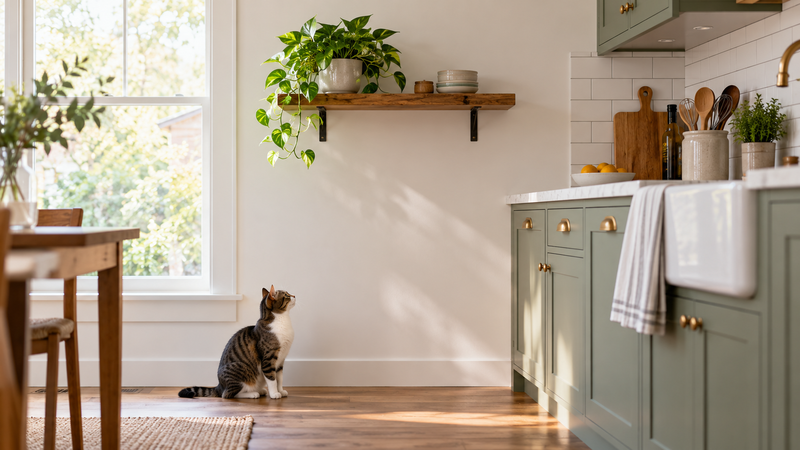
This small test is more informative than buying a group of plants at once. It shows whether the placement survives actual cooking, cleaning, watering and household movement.
There is no universal best species. Choose a healthy plant that matches the exact light, humidity and temperature, fits safely outside cooking and food-preparation zones, and is appropriate for pets and children in the home.
A bright, stable sill or side shelf can work when it stays clear of flame, hot grease, appliance vents, cabinet doors and strong sink splash. The plant should not reduce the usable preparation surface.
Schools and practitioners differ. An artificial plant can provide color and shape without care demands, but it is not a living Wood-element example. Keep it clean and do not present it as having a guaranteed energetic effect.
Do not rely on them for kitchen air quality. Ordinary houseplants do not replace a functioning range hood, exhaust, ventilation or control of smoke and moisture at the source.
Get a detailed feng shui report based on your zodiac, birth year and space layout.
View PackagesPowered by Shanyue Group | Contact: contact@shanyuegroup.com
About | Contact | Privacy Policy
© 2026 Shanyue Group • All Rights Reserved