風
fengshuiauspice.com
Good feng shui kitchen storage supports a calm, usable sequence: keep daily tools close to the task, leave enough counter space for safe preparation, place heavy items in easy-to-control lower storage, and separate food from household chemicals. Use ideas about balance and clutter as a cultural design lens, not as a promise that a container or cabinet position will create luck, health or wealth.
A kitchen can look tidy and still be frustrating to use. A frequently used pan may be buried behind appliances, spices may sit across the room from the stove, and an empty counter may have been achieved by pushing everything into one crowded cabinet. Storage works when it reduces unnecessary reaching, searching and carrying during real cooking.
Feng shui has many schools and interpretations. The Spurlock Museum of World Cultures describes it as a multifaceted tradition and notes that modern home discussions may frame balance through conditions such as light and dark or cluttered and sparse. This guide uses that broad idea carefully: visible calm matters, but so do access, cleaning and safety.
Before moving anything, watch what happens during one ordinary meal. Most kitchens contain a preparation zone, cooking zone, washing zone, food-storage zone and serving zone. These zones may overlap in a small room, but the repeated actions are still identifiable. Storage should shorten the path within each action.
Keep knives, boards and mixing tools near the main preparation surface. Store pans, lids and heat-safe utensils near the stove without blocking ventilation or creating a burn hazard. Put dishes near the dishwasher or drying area if that makes unloading simpler. Tea or coffee supplies can form a compact station away from the main cooking path.
This is more useful than beginning with a symbolic object. A decorative jar cannot compensate for a cabinet door that collides with the cook or for a pan stored where it must be lifted over someone’s head. If circulation or fixture placement is the central problem, use our feng shui kitchen layout guide before buying organizers.
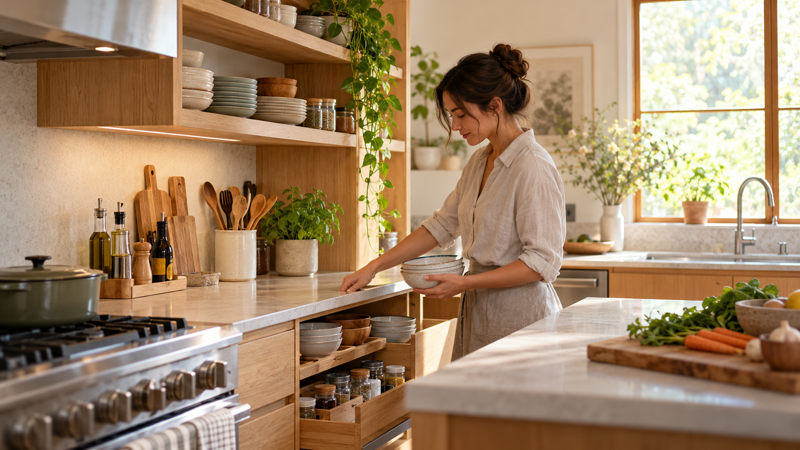
“Clear the clutter” is often translated into “hide every object.” That can create extra work. A kettle used five times a day, a safe knife block or a crock of cooking utensils may deserve counter space. The better question is whether each visible item supports a repeated task and whether the surface can still be cleaned.
Try a three-part counter audit:
Leave a continuous work area rather than many tiny gaps. In a small kitchen, even one reliable landing space beside the refrigerator or stove can reduce awkward carrying. Do not sacrifice required clearances around heat sources, vents or electrical equipment simply to create a decorative display.
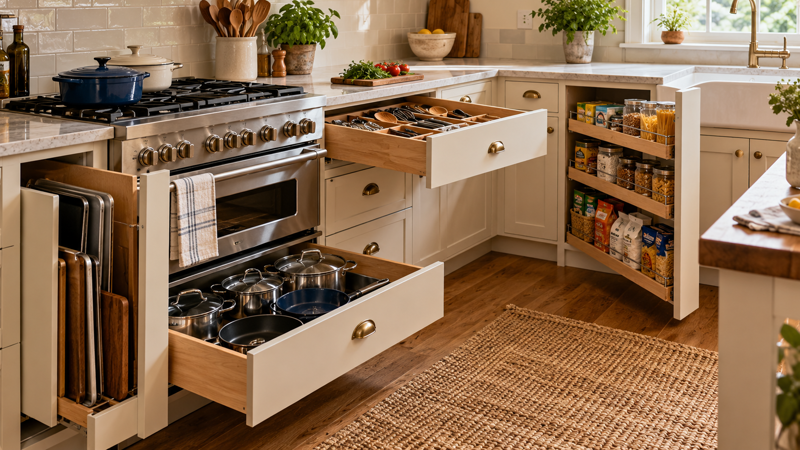
After defining the zones, sort items by how often they are used and how safely they can be moved. Prime storage is the area between roughly knee and shoulder height. It should hold daily dishes, regular cookware and ingredients used repeatedly. Higher and deeper cabinets can hold light, occasional items. Lower drawers are often a better choice for heavy pans than a high shelf.
| Use pattern | Good location | Examples | Check |
|---|---|---|---|
| Every meal | Easy reach in the relevant zone | Everyday bowls, plates, knives, boards | Can you retrieve it without moving another item? |
| Several times a week | Nearby drawer, shelf or pull-out | Pans, baking sheets, staple spices | Is the stack stable and easy to return? |
| Occasional | Higher, deeper or secondary storage | Large serving pieces, seasonal tools | Is it light enough to lift safely? |
| Rarely or never | Review before assigning space | Duplicates, broken gadgets, unused gifts | Would removal make daily work easier? |
Store lids vertically or in a shallow divider if stacked lids slide. Nest only items that can be separated without strain. Keep the heaviest piece at the bottom of a drawer, not on top of a fragile stack. An arrangement is not balanced if it looks symmetrical but requires unsafe lifting.
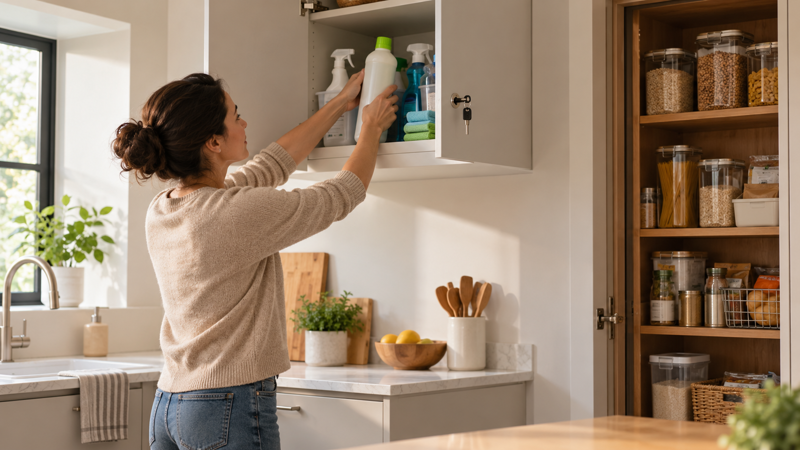
Safety rules take priority over symbolic placement. The U.S. Consumer Product Safety Commission advises keeping chemicals and cleaning supplies in a locked cabinet or box, out of children’s reach, and in their original child-resistant containers. Decanting a cleaner into an attractive unmarked bottle may look uniform, but it removes important product information and can create confusion.
If cleaners are stored under a sink, use a lockable space when children may have access and inspect the cabinet for leaks. Keep chemicals separate from food, dishes and food-preparation tools. Do not place food in a cabinet contaminated by a spill until the area has been cleaned according to the product instructions.
Food storage has its own requirements. Some foods are shelf-stable; others must remain refrigerated or frozen. USDA food-safety guidance treats refrigeration as a safety function and advises following manufacturer instructions. A beautiful open shelf does not make a food shelf-stable. Keep original labels or reliable identification and follow the storage direction on the package.
Use vertical space for light items, the backs of suitable doors for shallow storage and full-extension drawers for deep lower cabinets. Avoid adding so many racks that doors cannot close or the walking path narrows. One multipurpose tool is often more valuable than several single-use gadgets.
Open shelves can reduce visual weight, but they also expose items to grease and dust. Reserve them for objects used and washed frequently. A row of rarely used objects may create more cleaning than convenience.
Open-plan rooms are viewed from the living or dining area, so visual noise can spread beyond the kitchen. Group small loose items into one controlled zone, repeat one or two materials from the adjoining room, and give mail, keys and chargers a home outside the main food-preparation surface.
Do not design the kitchen only for the view from the sofa. The cook still needs safe movement, task lighting and reachable tools.
A cabinet reset is a low-risk way to test the method. Choose one cabinet that causes repeated annoyance, not the entire room. Empty it, clean it, inspect the contents and decide which activity the cabinet should support.
Measure only after the contents and task are clear. An organizer should solve a specific retrieval problem; it should not become another object that consumes space. If a simple tray or divider works, there is no need for a full matching-container system.
If you are new to the cultural vocabulary, read feng shui basics and keep symbolic interpretation separate from measurable conditions such as access, light, ventilation and safety.
No. Keep enough continuous space for safe preparation and easy cleaning, but daily-use items can remain visible when they have a clear function and stable location. A practical counter is better than an empty one that forces constant unpacking.
Place them near the stove in a lower drawer, pull-out or stable cabinet when possible. The best location lets you retrieve the correct pan without lifting a heavy stack above shoulder height or blocking the cooking path.
Only when the space is appropriate and household access is controlled. CPSC advises locked storage out of children’s reach and keeping chemicals in original child-resistant containers. Separate them from food and food-contact items, and check the cabinet for leaks.
Matching containers may reduce visual noise, but they are optional. Use containers only when they improve identification, access or protection. Do not transfer household chemicals out of original containers, and retain food storage instructions and reliable identification.
Get a detailed feng shui report based on your zodiac, birth year and space layout.
View PackagesPowered by Shanyue Group | Contact: contact@shanyuegroup.com
About | Contact | Privacy Policy
© 2026 Shanyue Group • All Rights Reserved