風
fengshuiauspice.com
A feng shui living room coffee table should support the way the seating area is used: easy to reach, comfortable to move around, and proportionate to the sofa. Start with the route through the room and the people who use it. Shape, finish, and decoration can follow those decisions.
This guide treats feng shui as a cultural and interpretive way of thinking about arrangement. It does not promise that a particular table will change wealth, relationships, or health. The practical test is whether the room works better when you sit down, stand up, walk through, and use the tabletop.
The received Zang Shu, Inner Chapters discusses qi, wind, water, and landforms in the context of burial-site interpretation. That historical context should not be turned into an ancient numerical rule for a modern coffee table. An interior arrangement can use traditional symbolism while still being judged through present-day needs and ordinary observation.
For example, describing a room as having a comfortable “flow” can help you notice an awkward obstacle. The obstacle is visible and testable: someone has to twist around it or move it to reach the door. You do not need to infer an invisible cause before making that practical correction.
Feng shui is not one universal interior rulebook. A peer-reviewed architectural study in Planning Malaysia distinguishes the Form School, which reads visible landform and shape, from the Compass School, which uses directions and a luopan. In its specific Five Phases case study, round forms were read as Metal and square or flat forms as Earth.
Applied cautiously to a coffee table, that gives a cultural symbolism, not a measurement or guaranteed effect. Someone using this Form School lens might choose a rounded table to evoke Metal or a square, flat form to evoke Earth, then test whether the actual object fits the seating and walking route. The study concerns architectural form, not an ancient coffee-table rule, and it does not show that either shape improves wealth or health.
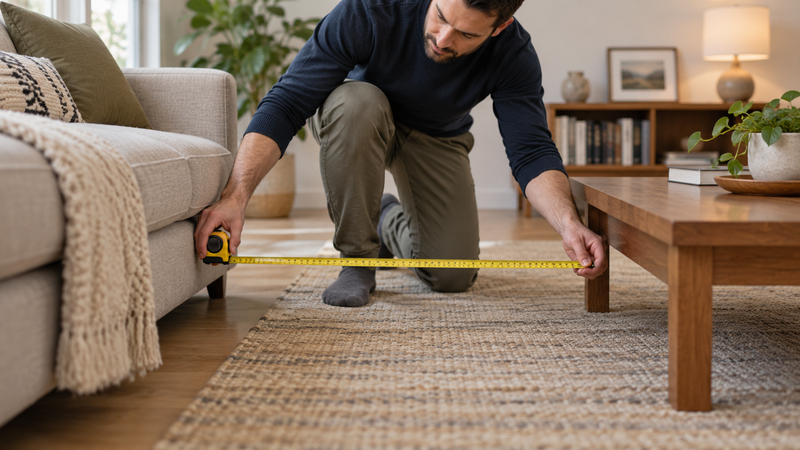
Place the table where a seated person can reach it without an exaggerated lean, while leaving enough space to get up. IKEA’s sofa planning guide suggests about 45 cm between a sofa and coffee table as a furniture-planning reference. Treat that as a starting point to test, not a universal feng shui measurement or an accessible-route standard.
The gap for reaching a cup is not necessarily the main walking route. Trace the path from the doorway to the seats and other exits. The U.S. Fire Administration’s escape-planning guidance emphasizes clear paths and doors and windows free of furniture obstruction. Preserve that route even if it means a smaller table, an offset position, or no central table.
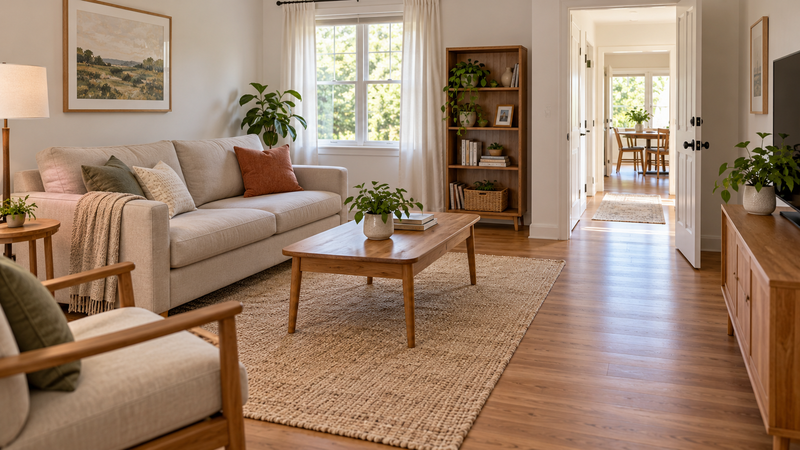
An oval or round table can be worth testing where people repeatedly turn around the table’s ends. A rectangular table can work well in front of a long sofa when its corners do not project into the route. Neither shape is inherently a guarantee of good fortune, and a large round table can still block a small room.
Consider the base as well as the top. Legs that splay beyond the tabletop can occupy a route that looks clear from above. Nesting tables offer flexibility only if the pieces have a sensible place to go when separated. A storage table also needs room for its lid or drawers to open without pushing people into another seat.
Use painter’s tape or paper to mark the proposed footprint before replacing furniture. Walk the route at your normal pace and sit in every regularly used seat. If you need extra room for a mobility aid, measure and test that actual use rather than applying a generic sofa-gap number.
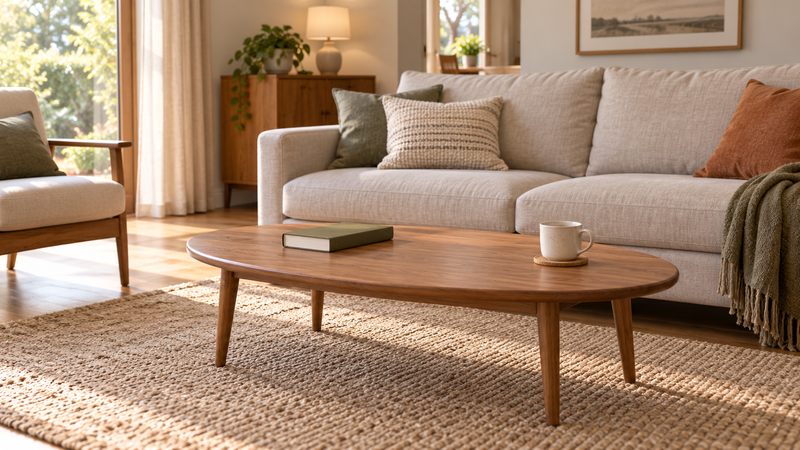
A table that looks balanced in a photograph may be awkward beside a very low or deep sofa. Test reaching a cup, placing a book, and standing up without striking the edge. If the table is also used for meals or work, consider whether that activity needs a different height or a separate surface rather than compromising the whole seating area.
Materials can carry personal or cultural associations, but they also bring practical tasks. Check stability, edge condition, cleaning instructions, and any manufacturer limits. A transparent top does not make its legs disappear, and a heavy stone top is not automatically suitable for a movable base. Evaluate the complete item rather than declaring one material universally favorable.
Keep enough clear tabletop for the activity you actually do. A tray may help gather remotes, but it should not leave nowhere to put a cup. Try removing one unused object before buying another decoration. What matters is the resulting use, not the number of objects displayed.
Live with a reversible adjustment for a few days and note what changes. Describe the outcome concretely, such as “the door now opens fully” or “the table is easier to reach.” For the surrounding seating decisions, continue with living room sofa placement and our living room layout review.
No. In one documented Form School and Five Phases interpretation, round forms symbolize Metal and square or flat forms symbolize Earth. That is a cultural reading, not a universal coffee-table rule; the actual footprint and seating route still decide whether the table works.
About 45 cm is one furniture-planning reference from the cited IKEA guide. Adjust it for comfortable reach and movement, and keep the main route separate. It is not an accessibility standard or a universal feng shui rule.
No. If a central table makes the room difficult to use, smaller side surfaces or a different arrangement may serve the household better. Test where cups and everyday items will go.
This guide makes no such promise. Choose through fit, stability, care requirements, appearance, and personal meaning rather than a guaranteed financial outcome.
Get a detailed feng shui report based on your zodiac, birth year and space layout.
View PackagesPowered by Shanyue Group | Contact: contact@shanyuegroup.com
About | Contact | Privacy Policy
© 2026 Shanyue Group • All Rights Reserved