Quick answer
For a practical feng shui living room TV placement, put the screen on a stable wall or purpose-built low console, keep the main walking path open, control window glare, and arrange at least some seating for conversation rather than making the television the only focal point. Traditional feng shui ideas can guide visual balance, but they do not produce guaranteed luck, wealth, or health. Mounting, ventilation, and child safety come first.
TV placement checks at a glance
| Question | Useful starting point | Reason to reconsider |
|---|---|---|
| Which wall? | A stable wall with limited direct glare and a clear cable route | The screen blocks a path, door, window, or heat source |
| What furniture? | A purpose-built low media unit or correctly rated wall mount | A narrow dresser or unstable cabinet supports the TV |
| How central? | Visible from the main seats without dominating every view | All chairs must point at the screen and conversation becomes awkward |
| What about reflections? | Test the screen in daytime and evening light | A bright window or lamp creates persistent glare |
| What comes first? | Manufacturer instructions, anchoring, ventilation, and safe cords | A symbolic preference conflicts with safety or access |
Start with the room’s real routine
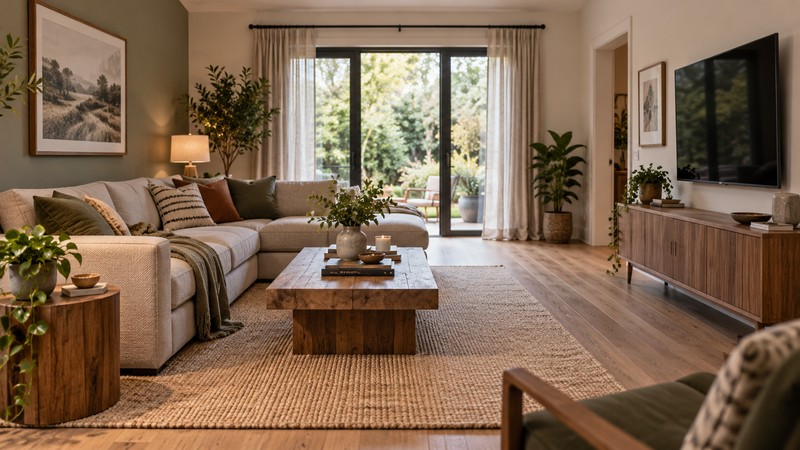
Before choosing a compass direction, note how the room is used. Is it mainly for films, daily family conversation, guests, children’s play, or several activities at once? The best position must support those routines. A screen placed beautifully on a plan can still fail if people cross in front of it, sunlight washes it out, or the sofa blocks the doorway.
Sketch the doors, windows, fireplace, fixed shelves, radiators, and outlets. Then mark the natural route through the room. The television should sit outside that route, with cables kept away from feet and furniture edges. If the main issue is circulation, review the broader feng shui living room layout before moving one object in isolation.
Treat the TV as one focal point, not the whole room
A dark screen has strong visual weight, especially on a pale wall. In a feng shui reading, people may describe that weight as active, reflective, or visually demanding. The practical response is straightforward: balance it with seating, art, plants, books, texture, or a second area of interest. There is no need to hide the television or pretend the household does not use it.
Avoid arranging every chair in a rigid row unless the room truly functions as a home theater. Turning one chair slightly toward the sofa, or placing two seats at an angle, creates a conversation zone while preserving a clear view of the screen. The existing living room sofa placement guide explains how support and walking paths affect the seating plan.
Compare common TV locations
| Location | Possible advantage | Practical check | Feng shui interpretation |
|---|---|---|---|
| Solid side wall | Can keep windows and fireplace visually open | Confirm viewing angle and cable reach | Often reduces the screen’s dominance |
| Main wall opposite sofa | Simple viewing layout | Prevent the television from becoming the only focus | Add balanced objects and conversation seating |
| Corner | Useful in small or irregular rooms | Avoid wasted space, twisting necks, and exposed cables | Can soften a rigid layout when scaled correctly |
| Above fireplace | Saves wall space | Check heat, clearances, mount rating, and viewing height | Safety and comfort override symbolic preference |
| Cabinet or sliding panel | Reduces visual emphasis when closed | Maintain ventilation and easy access | Supports a quieter room when the screen is off |
Control glare without blocking useful daylight
Do not decide from an empty room at one time of day. Turn the screen off and look for bright window reflections in the morning and afternoon. Then test the usual lamps at night. Moving the TV to an adjacent wall may solve glare more cleanly than covering a window all day.
Use adjustable curtains, shades, or lamp positions when the screen and window must face each other. Avoid placing a bright bare bulb directly behind the viewers or reflected in the screen. A calm room can still be well lit; the goal is controlled contrast rather than darkness.
Keep seating comfortable and supported
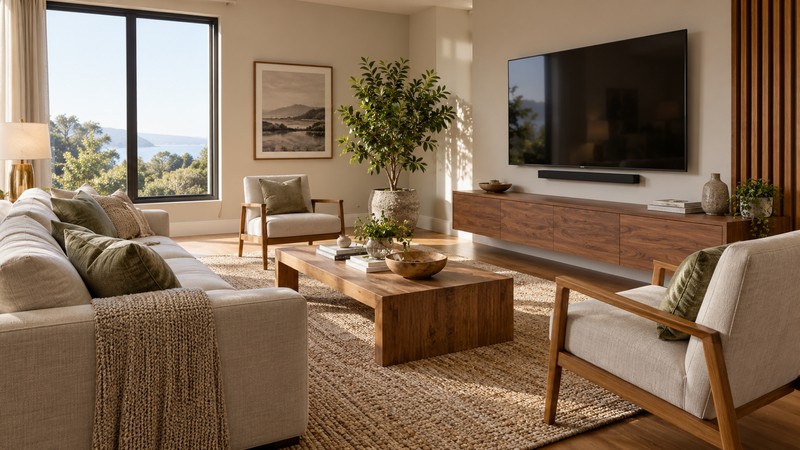
Place primary seats where people can see the screen without repeatedly turning the neck or looking sharply upward. A very high screen may free wall space but create an uncomfortable viewing angle. Use the mount and television manufacturer’s height and distance guidance for the actual model.
Feng shui discussions often prefer a sofa with a solid wall behind it and a view of the entrance. Treat that as a design prompt, not an absolute rule. A sofa can work away from a wall when the room needs it; a console, clear circulation, and appropriate scale may provide visual definition. Do not sacrifice an accessible doorway or safe distance just to follow a simplified diagram.
Make mirrors and reflections deliberate
When the television is off, its glossy surface behaves somewhat like a dark mirror. Check what it reflects from the main seats and the doorway. If reflections feel busy, a slight angle change, a matte surrounding wall, or adjustable window covering may help.
A separate mirror can multiply the screen’s movement or reflect bright light into viewers’ eyes. The concern is visual comfort, not a guaranteed event. Use the practical checks in the living room mirror placement guide before combining two reflective surfaces.
Put mounting and cable safety before symbolism
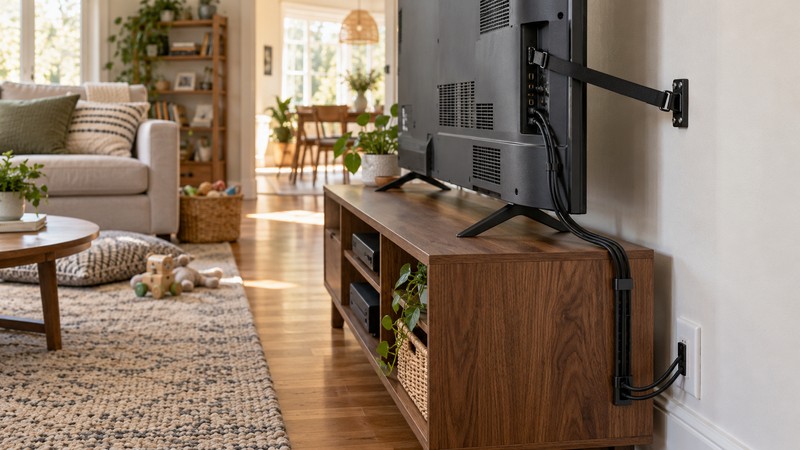
The U.S. Consumer Product Safety Commission advises placing televisions on furniture designed to hold them and securing TVs that are not wall mounted. Its Anchor It guidance also recommends sturdy, low bases and keeping tempting objects and cords away from children.
Follow the mount and wall-hardware instructions for the television’s weight and wall type. Leave required ventilation around electronics. Route cords so they are not pinched by furniture or stretched across a doorway. The National Fire Protection Association’s home safety checklist warns against running electrical cords where they can be damaged, under rugs, or across doorways.
Use traditional ideas with clear limits
Some feng shui schools connect directions, the five phases, timing, or a household member’s chart with room decisions. Those methods are not interchangeable. A short online claim that every TV must face or avoid one direction strips away that context.
If you follow a particular school, apply its full method after the practical layout works. The television’s direction cannot guarantee wealth, health, relationships, or success. A stable installation, comfortable seating, clear path, and manageable glare provide results you can directly observe.
A step-by-step placement test
- Mark doors, windows, heat sources, outlets, and walking paths.
- Choose two possible walls that can safely support the television or media unit.
- Use painter’s tape to outline the screen at the proposed height.
- Sit in every regular seat and check the viewing angle.
- Check window and lamp reflections in daytime and at night.
- Confirm the mount, furniture, ventilation, outlet, and cable route.
- Arrange at least one chair or seating group for conversation.
- Add plants, art, or storage only after the safe position is settled.
Frequently asked questions
Where should a TV go in a feng shui living room?
Choose a stable wall or low media unit that keeps the main walking path clear and does not force every seat to face the screen. Control window glare and preserve a comfortable conversation area.
Can a TV face the front door?
There is no universal rule that makes this automatically good or bad. Check whether the screen becomes the first and only focal point, whether reflections are distracting, and whether the placement narrows the entry path.
Should I cover the TV when it is not in use?
A cover is optional. A closed cabinet, sliding panel, or dark screen can reduce visual emphasis, but it must not block ventilation or create extra cords and moving parts that are unsafe.
Can a TV go above a fireplace?
Only when the appliance and mounting instructions allow it and the viewing height, heat, and cable route are suitable. The symbolic preference is secondary to the manufacturer’s clearance and installation requirements.
Does TV direction guarantee good feng shui?
No. Compass methods differ across feng shui schools, and a direction alone does not guarantee luck, wealth, health, or relationships. Use a complete method if you follow a particular school.
Sources and further reading
- U.S. Consumer Product Safety Commission: Anchor It TV and furniture guidance
- CPSC: current tip-over prevention recommendations
- NFPA: home fire and fall safety checklist